Showing posts with label Movies. Show all posts

Sunday, June 08, 2008

One thing we have George W. Bush to thank for...

While watching a matinee performance of The Strangers today, one thing that kept going through my mind was how art might change when Obama becomes President. I mean, who knows, the world might still end in 2 years, at the rate it's going now, but I suspect that with such a drastic change in leadership and ideology, the whole culture will shift in one day.


It's pretty common knowledge that pervasive fear, uncertainty, unrest, and anxiety in society make for the best art, generally, and that in times like these, the darkness of people's souls is reflected on screen. Even if the films being created have no bearing, overtly, on reality or politics, they're still reflective of people's anxieties and moods. Remember the Clinton years? How fucking happy and prosperous and hopeful everyone was?

And remember how fucking boring all the movies were? Especially the horror genre. It became self-reflexive, jokey, funny, meaningless. And most decidedly not scary. Who knew that when Scream debuted in 1996, that it would effectively kill an entire genre of film for almost a decade? It's not Scream's fault. The original is actually a pretty great film; I've seen it numerous times. And you can't tell me that the first 10 minutes didn't totally scare the shit out of you. Drew Barrymore, alone in a house at night, being tormented by a psycho in a silly mask: dude, that shit was fucking scary. And then she ate it. The biggest star in the film got eviscerated and (literally) hung out to dry in the first 10 minutes. You knew Craven wasn't pulling any punches with this one.


But while watching The Strangers today, I thought less of Them, which everyone claims it to be a total rip-off of, and a lot more of that first scene in Scream. Which, it seems to me, it shares a lot more in common with.

I enjoyed the hell out of The Strangers, but it's by no means a perfect film. It's predictable, it lost me in a couple of places, due to its slightly meandering nature and the complete implausibility of the protagonists' behavior (I mean, seriously, why didn't they get in the car and leave immediately when it was clear someone was in the house....?), and the abruptness of its ending. It felt less like the killers got bored than the director got bored. The whole "inspired by true events" coupled with FBI statistics at the beginning is just fucking stupid, and the director, in the couple of interviews I've read, seems like kind of a douche. It's bleak. Even too bleak for me, possibly. The best horror films, in my opinion, at least offer a sliver of catharsis, in one way or another. But nope, not The Strangers.

All of which isn't to say that it's not a fucking terrifying film, because it is. Director Bertino has a gift for sound and timing, and hopefully he's not a one-trick pony. But contrary to what some people believe, I think this is a golden age of horror and thrillers. Just in the last couple of years alone, I think some of the best horror films in decades have come out: Hostel (both 1 and 2), The Descent, Cloverfield, 28 Weeks Later. And I'm sure I probably forgot one or two.

War, terrorism, a completely bloodthirsty, bat-shit crazy president, religious fundamentalism trying to run our lives, economic depression, environmental catastrophe. As much as I hate to say it, these are the makings of great horror. I don't know why I love horror films so much. Perhaps The Strangers is brilliant. Perhaps, like Funny Games, except without the sneering condescension, it's telling us that we can't have it both ways: we can't delight in the suffering and terror of our protagonists and get to have some catharsis at the end, too. That's just not fair, and in some ways, it's not moral. We made our decision to pay 8 bucks to watch these poor bastards die, and die is what they will do. It was our choice. We made it happen, now we must live with the weight of our decisions.

But why do we enjoy the process so much, then get so bummed when it ends the only way it could, and how we knew all along it would? And then leave the theater depressed? But...sort of...invigorated....

Maybe it makes us feel alive. Maybe it makes us appreciate that our mountain of school loan debt that keeps us awake at night is nothing compared to having our house invaded by masked psychos that make us watch while our lovers are slowly killed.

Who knows? But if Obama actually manages to make good on any of his promises, I'm going to miss these heady days of horror.

Friday, May 30, 2008

If you say, "I told you so," I'll punch you in the nuts

So, Tom and I tried to go see The Strangers tonight. And by "tried," I mean, we were able to get tickets, but found the circumstances intolerable.

For starters, we went to a mildly suburban theater in a mall. Even though they supposedly advertise that no one under 18 is allowed in the theater after 7pm on Friday or Saturday nights, it's a rule that is either clearly not enforced, or the age should be upped to 25, and even then only open to people who don't pay $9 to sit and talk to their friends.

The theater was full, but not really as bad as you might think. The final straw, really, was the guy sitting next to me, who constantly said things (very out loud) like, "Oh no," "Oh, shit!" and "Damn, girl." That was directed at Liv Tyler.

Before that, however, about 15 minutes into the film, four adults enter with a child in tow, who was probably about 4 years old.

Naturally they sat right in front of us.

I wasted about 15 seconds before storming out to the concession stand and finding the manager. Our conversation went something like this:

Me: Um, did you know there are people watching The Strangers with little kids? Like, very small children.

Manager: Are they making noise?

I wrinkle my brow at him.

Me: Um...well, there are very small children watching a rated-R horror film. That...doesn't concern you at all?

Manager: Well, are they talking?

Me: Well, yes, it's a small child, sitting right in front of me in a horror movie.

Manager: But is he disturbing you?

I get further confused.

Me: He's saying things like, "Mommy, Mommy," and talking. Out loud. Yes, he's disturbing me.

The manager looks at me blankly.

I stare back at him expectantly (story of my life).

Me: Can anything be done about this?

Manager: I'll go in in a few minutes.

Me: Okay, I'm sitting way up in the back, on the right side if you're-

Manager: I'll just look for you, and then the kid will be in front of you.

Now I stare at him blankly.

Me: Okay. Thank you.

I march back inside and inform Tom that we're giving it 10 more minutes.

After about 10 minutes (and I must say, I was enjoying the film, quite a lot), I stay true to my word and leave. (If you wanna know the truth, the crowd wasn't awful; it was the guy next to me that kept talking out loud that really pushed me over the edge.) I inform the girl at the box office that the crowd is "intolerable" and I want my money back, which is given back.

The End.

Even though I was very excited about this film, after sitting through an incredibly irritating 35 minutes of it, I'm a little less excited to go back and sit through that again, but I shall. It was just getting good when we left.

Friday, May 23, 2008

The Origin of the Fear of Masks

Probably no one really knows this about me (well, one person does), but I have an almost paralyzing fear of masks. I don't care what kind of masks they are, I hate them. Santa Claus maks, president masks, anonymous glassy-faced masks, the mask the guy in Halloween wears, whatever. I don't like it. The surest way to freak me out (and get me to possibly hate you) is to stare at me while you're wearing a mask. I have somewhat of a history with masks freaking me out in my life that I'm not going to detail here, but suffice to say, some of my most impressionable moments of being scared out of my mind in childhood involved masks. Both benign and werewolf.

So, while I don't care for Liv Tyler, and I have no idea who Scott Speedman is, but people seem to hate him, and I'm sure it sucks, the trailer for The Strangers really terrifies me. Naturally, I just assumed it was a Funny Games ripoff (and dear god, the only movie I've ever hated more than Funny Games is fucking Salo. Pasolini deserved to be murdered after making that soul-crushing journey to hell). Next on the list would be any Lars von Trier film. That man's not even human.

But I digress. I made the Funny Games - Strangers parallel immediately, but it seems there are some seasoned horror buffs that didn't really pick up on it. But since no one's seen the film, there seems to be some debate as to whether or not it is actually a ripoff of Funny Games, or is just being marketed that way. And while I did despise every moment of Funny Games (well, in all fairness, I didn't finish it; when they blast the little kid's brains all over the wall in front of his mother, I'd had enough), I can appreciate the point it's making. Too bad it's such a condescending, elitist and hypocritical point, but nevertheless, I think it's smart.

But the one thing The Strangers has going for it, for me, is the masks. I have to admit, though I know it will be total tripe, I'll probably see it. Any movie that can genuinely freak me out, I appreciate. And sometimes a silly mask is all it takes.


(As a sidenote, I'm also very excited about Mamma Mia. I can't help it; it looks fun.)

Sunday, March 02, 2008

My Blueberry Nights


My favorite thing about Wong Kar Wai's films in general is that they're just honest. They're never cynical, or pessimistic, but they also never shy away from the soul-shattering devastation that often accompanies love. Sometimes there isn't a happy ending. Sometimes the girl just leaves to go to California and doesn't come back. Or the man picks the other woman. The end. There is no one else waiting across the street.

But even in the pain, there's always hope. The characters move on. They cry. They suffer. They grow. They clean house. Repeatedly. But his optimism is sincere, and doesn't have the cynical ring to it that so many Hollywood romantic comedies do, where you know that no one involved in the film actually believes in any of it, they're just giving the audience what they think it wants.

My Blueberry Nights
is a strange movie. It's probably Wong Kar Wai's most flawed film, but also it might be one of my favorites already. I watched it twice last week, 2 nights in a row, and I haven't stopped thinking about it all weekend. It almost feels like an imitation Kar Wai film, made by somebody who knows what they're doing and knows how to hit all the right notes, but just falls inexplicably short somewhere along the way.


For one, there's some really weird violence in the middle of it that's never really showed up in his films before, and one scene even veers very uncomfortably close to being frighteningly mysogynistic. Is this intentional? Is he trying to play to American sensibilities (or critquing them), or am I just reading too much into it? Both times I watched the film, though, the scene disturbed me. A lot. Not least because you're called to identify so strongly with the perpetrator, and afterwards, no one in the film seems nearly as disturbed by any of it as I was.

But, like all of his films, there's also such a sweet sadness to it. Chan Marshall (aka, Cat Power) makes an all-too-brief cameo, and for some reason the weight of her scene just killed me both times I watched it. Even though nothing really happens in it. It's just about that lost connection, that fire in your heart that slowly dims, but never really goes out.


Which sort of seems to be what the whole film is about. The pain is never denied. But there's a way through it. Sometimes that journey is physical, sometimes it's solely emotional. But there's always a way. Blueberry Nights is a road movie through the terrain of the broken heart, from one side to the other. It's more than a Band-Aid, but it's never fixed, either. It just is what it is. There's always more for you out there, the film says, if you're willing to be brave and embrace it.

Monday, February 25, 2008

"Noisy ghosts"


On Saturday night I caught an unedited broadcast of Poltergeist, which was probably one of my favorite films of my youth, and by far my favorite horror film. I must have watched that movie 20 times on HBO, and then when it came out on VHS, I rented it multiple times. I have no idea what attracted me to it so strongly when I was a kid, but I have no doubt, after watching it the other night for the first time in years, that it was the most influential film of my childhood.

I guess I never realized just how scathingly critical it is of the suburbs, and sprawl, and reckless development. The patriarch of the Freeling family, Craig T. Nelson, plays a somewhat bumbling and disingenuous realtor/developer who can't even muster up enough enthusiasm towards his own cookie-cutter subdivisions to sell them to families desperately hungry for a place to call home. JoBeth Williams is the ideal suburban, stay-at-home mom, excpet that she was also a teen mother and is still a pothead. Though both of these things are presented quite matter-of-factly and entirely without judgment. When the home is first invaded by the "TV people," and they're playing harmless pranks, she's so excited for a distraction from the mundacity that she can't even contain herself.

The film turned the national anthem into an ominous signal of doom, and, even as a child, made me start questioning what was underneath the everyday blandness of everything shiny.


Mocking the complicity and peace of the suburbs, or at the very least, turning over the rock and looking at what lies underneath it, has been a staple of indie film since the 80's at least. But I bet Poltergeist was one of the first, mainstream, star-fueled films to take a sledgehammer and ax to Middle America and criticize everything it holds dear. And then sell their clueless optimism back to them in what is no less than a raging, politically-driven popcorn movie.

Spielberg kind of specializes, I guess, in looking at the extraordinary among the oridnary (i.e., weird shit in boring-ass suburbia), but Poltergeist felt to me like a particularly angry and frightened film. Like nothing less than a warning call to Americans everywhere mindlessly gobbling up resources, and rotting their brains with television and soulless lives.

Maybe I'm reading far too much into it, but it seems so obvious when I watch it now. And makes me like it that much more.

Full-length Sex

So, the site of my original post removed, but some site called Jezabel still has the Sex and the City trailer.

I know, I'm obsessive: I've watched it about 20 times. I'm sure I'll see it in the theater 6 times. This particular post has some snarky commentary too, that's sort of amusing.

God, it's a good thing they can't make a Six Feet Under movie.

Tuesday, January 29, 2008

What do your favorite films say about you?

Two Los Angeles-based film buffs, friends and cognitive behavioral therapists have just written a new book determing your personality type and corresponding cinematic hero based on your ten favorite films.

That’s according to “Cinescopes” (Quirk Books), a book out this month that blends the cinematic savvy of Roger Ebert with the psychological models of Carl Jung.

The book determines your personality type — and an equivalent cinematic hero — based on your list of Top 10 Favorite Movies of All Time.

What we love to watch on the big screen provides a window to our psyches, the the two authors of “Cinescopes” contend.

Your favorite films “reveal both what you are, and what you want to be,” co-author Risa Williams says. “If you’re a Vivacious Romantic, you’re definitely looking for love. But it’s also a glamorized view — how you hope to see yourself.”


It began as a web site where people could submit their lists and get an analysis, but after awhile, the therapists started noticing patterns (of course they did), and with some Joseph Campbell archetype referencing going on, they developed 16 personality models.

I'm not sure exactly how the book works, exactly, but it lets you run your own lists and determine the results. That would be fun.

Now the only problem is coming up with my definitive top 10 films; that's a lot of pressure.

You can submit your own list at the Cinescopes web site. As soon as I figure out my 10, I'll let you know what my results are. I'm excited!

Monday, January 14, 2008

Cruising

(THIS POST HAS BEEN UPDATED SINCE IT WAS ORIGINALLY PUBLISHED.)


If I'd seen Cruising when I was a teenager, I'm pretty sure I would have stayed in the closet another 10 years and never left the relative safety of my small hometown. For a movie so filled with such nastiness, such brutality, such wanton disregard for life, humanity, or even fun, charges that it's homophobic are just lazy. And dumb. I concede that I may be a bit more liberal in this arena than your average gay: I have a pretty high tolerance for various representations of how to live in the name of "freedom of expression." Which is one reason I fucking hate groups like GLAAD. In the past they have actively called for boycotts of writers (gay ones!) because they didn't feel that their work accurately represented the "gay community" in a positive enough light to suit their political agenda. (In fact, back when I fancied myself a filmmaker, one of my major career goals, I shit you not, was to someday be boycotted by GLAAD; that's when I would have known I'd made it.) Which I guess is why politics and art shouldn't mix.

In Cruising, William Friedkin makes no attempt whatsoever to accurately portray the whole of the gay community. It could even be argued that he makes the argument that repression of your true self (i.e., your gayness) can turn you into a self-hating murderer of other gays. Perhaps the film should be subtitled: Free To Be You and Me: Don't Hate! As he explains in the vignettes on the recently re-released DVD (which has a crystal-clear screen image, and lightens up a whole lot of that "background action" that was supposedly darkened for the release almost 30 years ago), to him it is simply a murder mystery, that just happens to be set in this realy extreme underground culture of gay S&M in New York City. Maybe that's a cop-out, but he also admits to understanding where the protestors are coming from, and why a lot of gay people feel maligned by the film. It is, however, as he also points out, a subculture that really existed at the time, and was going strong. He didn't make it up. By no means was every gay person participating in it, but a lot were, and if nothing else, it just looks terribly boring. I totally understand the euphoric thrill of anonymous sex, but when you're laid out in a sling, your legs in the air, and three guys are standing around taking turns fisting you (as is portrayed fairly explicitly in the film), one wonders where exactly the pleasure is. A prominent hallmark of genuine sexual addiction is the loss of enjoyment associated with actually having sex: it all becomes about the chase, about the procurement, about the bigger and bolder risks. The actual sex ends up being beside the point. All addictions are degenerative, and behavioral addictions are certainly no exception.


More than anything, though, Cruising is just depressing. Despite the killer being caught (sort of), it ends on a vague and unsettling note implying multiple things (SPOILER ALERT!): that Al Pacino has possibly been "turned" gay by his undercover research, and that Al Pacino is possibly a hideous murderer, preying on the most innocent among us and committing one of the most brutal crimes throughout the entire film.

It's an open-ended, dubious, and ambiguous movie through and through. But despite how unpleasant it is, it's also kind of brilliant, for a lot of the reasons I just mentioned. It has a lot to say about identity and how society can shape a person, particularly at a time when homosexuality was still very scary and/or exotic to most of the population. Whether or not William Friedkin really understood what was going on in the gay world at this point in time is left unanswered. I wonder if he knew that this explosion of sexual activity and obsession was a result of having been repressed for so long, and finally going insane with feelings of liberation? Is it possible that the characters in the film have so much sex simply because they can, and not even because they want to, or get any pleasure out of of it? Maybe Friedkin is actually a total genius and is making a prophetic comment about the ravages of unchecked decadence and hedonism. After he slaughters each of his victims, the killer says to each one in a deadpan purr, "You made me do that." Is Friedkin calling out the gay community for self-destructing?

Eh, it's definitely a stretch, but an interpretation I kind of like.

On a related note, I decided a couple of months ago that I thought it would be fun to try to watch as many movies as possible set in NYC during the 70's, back when it was still dark, ugly, dangerous, and only crazy people wanted to live there. Before the Disneyfication and Sex and the City turned it into a sunny, pastel playground of nice restaurants and martinis. As luck would have it, Scott Heim, author of the novel Mysterious Skin, had a post on his blog recently about that very subject, and his top-10 favorite films set in New York City from the 70's, which includes Cruising and The Warriors, which I've seen, but not any of the others. Maniac looks especially...fun.

Tuesday, December 18, 2007

If you have no other choice

Last night I went to I Love Video with the intent to rent Night Train Murders after hearing Eli Roth talk about what a huge influence it was on Hostel 2 on the commentary of that movie (which is great, by the way; I highly recommend it), but instead impulsively rented a little documentary called Follow My Voice, about recording a tribute album to Hedwig and the Angry Inch by a bunch of indie rock hipsters (Sleater-Kinney, Ben Folds, Frank Black, Jonathan Richman, Polyphonic Spree, They Might Be Giants, Cyndi Lauper, Yo La Tengo, The Breeders, Stephen Colbert, and a few more).

Mixed in to behind the scenes recording of the record, however, are video diaries of several teenagers attending the Harvey Milk High School in Manhattan, which is a school composed primarily of gay and transgender students (and what proceeds of the CD are benefitting), but open to anyone who wants to come there because they don't fit in at a regular school, or they feel threatened, or whatever. At first the video diaries kind of annoyed me, and I thought they were boring, and I just wanted to see more bands doing awesome songs, but the longer the movie went on, the more it roped me in. I started to see a structure to the film, which is that it was taking the themes of the songs and weaving it into the themes of the kids' diaries to, essentially, create the structure, or plot, of the documentary. It's subtle, and doesn't always work, but when it does work, it's incredible. I got all choked up watching a transgender teenager getting her hair done for prom, while the Polyphonic Spree performed "Wig in a Box" (perhaps my favorite song from the whole movie), which is totally ridiculous, but it just works.

All in all, it turned out to be a really inspiring film, and the scene towards the end, when the high school finally opens as a fully-accredited high school in New York, and the police have to set up fencing to keep back the protestors, but the kids walk through anyway, beaming, as they are also cheered on by many, many supporters, just warms the heart and really gives one hope. (It's also quite reminiscent of footage of the integration of Central High in Little Rock back in the 50's, which is some of the most amazing stuff I've ever seen.)

Okay, I know I'm not being very eloquent here, but I just woke up. If you love Hedwig, or just love rock-n-roll, or just love great documentaries, check it out. You can buy the CD here, though I'm not sure the proceeds are still going to the school, since I checked the actual web site of the record label, and it no longer exists.

In the meantime, enjoy some "Wig in a Box" from the movie!

Sunday, November 18, 2007

Too Many Movies?

A few minutes ago I'm sitting at my desk in my bedroom, happily playing email Scrabble, when I hear footsteps underneath my window. Ask anyone who knows my backyard, and they'll tell you it's creepy at night. It's gigantic, and extremely dark, and lined with shrubbery around the entire fence that protrudes a good 10 feet into the yard.

I know I heard the footsteps, because my desk is right up against the window and my window is open. So despite the fact that I can't see shit because it's too dark (I never shut my blinds), I hear them and I stop. I perk up. The footsteps stop, then I hear them again, very distinctly the sound of two heavy feet walking on the dead leaves, going in the opposite direction. And it truly sounds like they're about 4 feet from my window. I have a door in my room that goes into the back yard as well, so first thing I do is look over at the door to make sure it's locked.

My roommate Garrett has a telescope he likes to take out into the backyard sometimes, so I leave my room and go knock on his door, thinking maybe it's him outside messing around, but he answers from inside his room, so obviously it's not him. However, he decides to go investigate with me.

I grab a hammer and a flashlight and we go outside. We scour the entire backyard and of course find nothing, but I swear to god it was not my imagination. Yes, I looked at about a hundred videos of ghosts today and watched Session 9 tonight, which was creepy as shit, but I heard it, and I stand by my story.

Both sides of the backyard have big gates, and the one on the north side is always standing open, and fairly secluded by a garage apartment (and that person has moved out, so I know it wasn't her; it's empty right now), but it's still there. Yesterday I saw two homeless people walking down the street, the state hospital is 3 blocks away, and a couple months ago, as I rounded the corner onto my street riding my bike home from work late one night, some cops had the entrance to the street from the main road blocked off and several cops were walking up and down my street with their flashlights. I didn't ask any questions; I just went inside and made sure all the doors were locked.

So even though it was probably nothing, it's not completely ridiculous that someone could have been in the backyard. And I'm still sleeping with the hammer next to my bad tonight.

Thursday, November 15, 2007

Television Killed the Cinema Star

An early October issue of Entertainment Weekly that I was reading in the breakroom at work tonight had a fluffy, but mildly interesting article (isn't that every article in EW?) about why no gay movies have been made in the 2 years since Brokeback Mountain was such a critical and economic success. Particularly, it noted, since gay characters have become so ubiquitous and popular on television. The article offered several theories for this, like that studio producers and executives tended to be old, white men who have had their jobs for decades compared to TV producers, which have a much higher turnover rate and tend to be much younger and more diverse, and that there simply aren't any good "gay scripts" out there (which I tend to have a hard time believing; or, well, after programming the Austin Gay and Lesbian Film Festival for 2 years, maybe I don't....).

Whatever the case may be, they had a quote from Alan Ball saying that one reason he saw for this was that so many gay films tended to be about issues (AIDS, coming out, discrimination), and that being gay was the main thrust (ahem) of the story. Whereas on television, you have hours and hours and hours to slowly and subtley reveal a character's true, well, character, and make relationships so much more nuanced and realistic.


This is what drew me into television to begin with, and why I think really incredible television shows have pretty much killed my love of movies. Anymore, 2 hours simply isn't enough time for me to invest in characters that I like. I've never been terribly interested in plot, which could explain why I generally hate mysteries, thrillers, and action films. A good story is nice, but I enjoy television and film for the characters and the richness and intimacy that watching people develop over years can bring you.


All of my favorite shows (Sex and the City, Six Feet Under, Nip/Tuck, Friday Night Lights) have all been character-based, and about extraordinarily complex and nuanced characters (well, maybe not Sex and the City so much, and only the first 2 seasons of Nip/Tuck; seasons 3 and 4 got very plotty and stupid and totally sucked). And not only that, they've all been set in very specific "worlds" (high-fashion New York; a funeral home; a high-end cosmetic surgery hospital; small-town Texas) that generally have very prescribed ideas about how things should be, and all feature characters either creating or breaking those molds and boundaries. So, in another sense, I guess all of those shows have also been about identity and defining oneself within the confines of whatever world it is the characters are existing in.


With movies everything has to be so glossed over, so quick, so surface. With television shows, relationships can begin and end in real time; people can grow up, or change, in such slow and realistic ways, that when you go back and visit them again at the beginning of whatever show it is compared to the end of the show, you can really see the progress and change, whereas you might not have really noticed it while watching the show. In TV shows, characters don't have to have revelatory epiphanies and a conclusion like they do in movies. That's not real life. I'm not knocking movies here, I'm simply saying for my money, movies just don't cut it for me anymore. I like to be able to grow with my characters and become intimately involved in their lives. (To this day, I still maintain that I've never seen a movie that can rival Six Feet Under for me.)


Which goes back to Alan Ball's comment. A lot of emphasis in the gay rights movement has been placed on being "out" and visible, and how that, more than anything, has helped the cause. Because the more people that know gay people, and realize that they're not all AIDS victims, or serial killers, or political activists, the more the regular population will see them as just being regular people. If a middle-aged soccer mom in Iowa who's never known a gay person can watch Six Feet Under and watch David struggle with his sexuality over 5 years, and become really attached to him, and the show can humanize this character and make the anxiety and fear of that struggle very real to this woman, in a way that a film never could (despite how great Brokeback was, it was still two very famous, heterosexual actors playing dress up, and that's impossible to forget while watching it), then I say, bring on the TV.

Friday, November 02, 2007

and nowhere shines but desolate


Immediately after watching Suddenly, Last Summer on Monday, I was struck by the amount of vitriolic hatred it seemed to espouse toward homosexuals, and that I didn't think I'd ever seen such a gratuitous manifestation of the gay man as sexual predator in any film before, ever. Which I found particularly interesting, seeing as how it was based on a stage play by Tennessee Williams, and the screenplay was written by Gore vidal (both of whom, as everyone knows, are very Famous Homosexuals). Another interesting piece of trivia that I wasn't aware of was that Montgomery Clift, who plays the doctor, was also gay, and was apparently treated very badly by the director for this reason.

Despite my 5-star rating on Netflix, because it was so much fun to watch and marvel at, I kind of consider it a film beyond rating, or even beyond criticism. Not because it's so transcendantly good, or stands out as some kind of untouchable artifact from its era, but simply because it's so god-awful. The movie is essentially a geek show, an unbelievably overwrought 2-hour shriek from the very depths of Williams' twisted and tortured psyche, a piece of work rumored to have been written as therapy for himself, which means it probably should have stayed hidden somewhere, locked away in a box.

I am being a little unfair, since I've neither seen nor read the play, which is apparently just 2 long monologues, and it might be quite different. Vidal claims in Vito Russell's The Celluloid Closet that the studios made the screenwriter drop every overt reference to homosexuality in the script, and made the director turn the homosexual himself into a faceless, voiceless shadow (if you've seen the film, you know what I'm talking about). This dehumanizing element of the film is probably most responsible for turning it into the unsettling creepshow that it is.

Over the last few days, though, I've come to start thinking of the film a little differently. (I also can't help but wonder how differently it would have turned out had the studios not imposed such strict censorship.) The film, I think, is basically about a man who is literally consumed by his own unquenchable desires, but rather than blaming the victim (which I did after viewing the film, and which I think is an inherent psychological factor the film exploits) perhaps it could be taken as a parable of what repression can do to a person. Taken less literally and more of a metaphor might be a more balanced interpretation, but nevertheless, the histrionics and melodrama pretty much kill any kind of serious reading of the film. Whether this was simply a product of 1950's movie-making, where lots of shouting and over-emoting was kind of the order of the day, or a deeper symptom of pervasive homophobia and mysogyny is impossible for me to discern.

Nuance and subtlety are not hallmarks of any of Tennessee Williams' plays (at least in the film versions), but they do all contain deeper and more interesting undercurrents than does Suddenly, Last Summer at first glance. A Streetcar Named Desire has a real broken heart at its center (or, more appropriately, 3 broken hearts), and Paul Newman showed incredible depth in Cat on a Hot Tin Roof as a man completely broken, both physically and emotionally, on the verge of total collapse. Despite the hysterics and shouting. Suddenly, Last Summer comes off more like a right-winger's fantasy of the moral deprivation of gay men and their lustful, predatory nature. But all the Freudian elements are there for display if one cares to look, and judging by the rash of today's headlines, it doesn't seem too off the mark to concede that perhaps Williams was really onto something in this one. Grotesque though it may be.

Sunday, October 14, 2007

Why French philosophers shouldn't make French films

Having just suffered through Twentynine Palms by Bruno Dumont (which, incidentally, took me 4 viewings to get through), I have just one thing to ask: what the fuck is wrong with French people? If the cinema that gets exported from France is any indication of their national mood, no thanks. Or maybe I'm just watching the wrong movies, but my god, it is so unpleasant.

Aside from some 60's new wave stuff, I think I've only ever seen one French film I liked. Ever. And what is their obsession with showing women going to the bathroom?

Twentynine Palms is like some kind of existential trip to hell if hell is other people. Two of the stupidest and most irritating characters ever laid to celluloid drive a giant red Hummer through the desert outside Palm Springs, ostensibly to scout a location for a photo shoot, but not a single photo is ever taken of anything. Furthermore, the "couple," or whatever they are, seem to despise each other. One moment they're laughing, the next she's storming out of the hotel room and running into the street, the next he's raping her mouth and jizzing all over her face and she's crying because she loves him so much. Then they fight again, then they get ice cream, then they fuck in the hotel pool, then they drive through the desert again and fight about something, then he practically rapes her on a rock, then she cries, then they have dinner and laugh, then they fight again, then they fuck in the hotel room and she cries. Ad nauseum.

Lest you think I'm exaggerating, I'm not. Then at the end they get attacked by rednecks who smash the dude's face in with a baseball bat while they rape his ass, and strip the woman and beat her up and make her watch, but don't rape her, then the couple goes back to the hotel, where the guy flips out, scalps himself, and stabs the girl repeatedly in the stomach on the bed. And all that last bit of violence literally happens in about the last 4 minutes. The End. Nothing. Null. Void. Delete. Life is hopeless and pointless.

Bruno Dumont believes in nothing and in his desperate and pathetic world, people are nothing but meat and orifices to fuck. He now belongs to that esteemed club of Lars von Trier, Catherine Breillat, Passolini, Gaspar Noe, and perhaps Michael Haneke (though I'm willing to cut that guy some slack, because at least he has a brain): artists who so hate themselves and everybody else that they're willing to sacrifice their own humanity just to make everyone else suffer too. Maybe some day they can all have dinner parties together in hell and torture and rape each other repeatedly for entertainment.

Wednesday, August 22, 2007

Don't get mad, get even!

Today I went with a friend to see a $2 matinee of Hostel 2 at the Millennium Youth Complex over on the east side. (Incidentally, we arrived smack dab in the middle of the Friday Night Lights crew shooting something there. When we walked in, someone at the door asked us if we were there to be extras, and we said no; I really wish I’d had the foresight to say yes, but I’m sure they had a list or something anyway.)

I don’t care much for this new breed of horror film that’s become very popular in the last few years, otherwise known as “torture porn” by those hipsters in the know. I think “torture porn” is just about the dumbest label ever applied to any genre of film ever, by the way. I don’t quite understand why a film like Hostel gets stuck with such a simple-minded moniker, since that film contains about 2 minutes, tops, of actual violence, while a movie like, oh, I don’t know, A Nightmare on Elm Street, which came out almost 30 years ago, contains scenes of a far more savage and prolonged nature, and it’s hailed by pretty much everyone I know as a brilliant horror classic. I’ve seen only the first Saw movie, which I hated. I haven’t seen Wolf Creek, either of the Hills Have Eyes remakes, or Captivity. I saw Haute Tension, which I thought was awful, and I saw the Texas Chainsaw remake, which I didn’t think was awful, but didn’t think it was good, either.

What I realized watching Hostel today, was that I think the reason it gets such a bad rap by critics and bloggers the world over, is because it’s actually a good film. Which is also why, I think, I loved both Hostels, but hate all the other movies that get lumped in with it. (Or at least I assume I would hate them if I bothered to watch any of them, which I never will, because frankly, I just don’t care.) I find the buildup and tension in both Hostel films to be almost unbearable; in fact, the anticipation I find far worse than the violence itself, which is usually brief and quick (though, admittedly, pretty brutal). I think that’s the sign of a powerful and intelligent filmmaker, which I also think is what pisses everybody off about those movies. Roth does an incredible job of creating an atmosphere of such intense dread and foreboding, that my heart was beating out of my chest before anything even happened. And isn’t that what a good horror film is supposed to do? I also realized that Roth, at least in my opinion, treats violence with the gravity, and soul-crushing respect that it deserves. I mean, shouldn’t violence be unsettling and hard to watch? I find flippant portrayals of violence (such as those in Tarantino movies, for instance, or even in crap like Die Hard) to be far more offensive and cruel than anything in Hostel. You should dread seeing violence, it should make you quiver and shake and uncomfortable. I think Roth treats his characters with more humanity and respect than most horror films do. He gives them lives, and backgrounds, and makes you feel genuinely bad and upset at their suffering, rather than a participant in it.

Anybody who has an even rudimentary understanding of psychology knows that the root of anger is a feeling of helplessness. Which, I guess, is what so confounds me about the anger directed towards these crappy little stylized pieces of pop culture throwaway. Which is ultimately all that they are. They’re movies, for christ’s sake. If the people complaining the loudest about them weren’t also the same people lining up on opening night to be the first in line to see them, I might be able to take their righteous anger a little more seriously than I do, but I just can’t. What is it about Hostel, in particular, that gets people so fired up, and what is it about the existence of these films that makes people feel so helpless (although they’re all putting their money towards making more of them, so maybe they’re not that genuinely angry about them, after all, who knows)?

I haven’t learned a whole lot in my 30 years of life that’s very useful, but one thing I have learned is that anger without action is useless and eats at your soul. Anger left to fester will just make you hard, and cynical, and bitter and mean. Maybe getting out there and marching across downtown with your anti-war sign won’t mean a thing to the lunatic in the White House, but maybe it will just make you feel better. Maybe volunteering at a women’s shelter won’t make all the domestic abuse in the world go away, but it will make a difference in someone’s life, and it will make you feel a little more in control of a chaotic and scary world than maybe you thought you could. Maybe after your heart’s been shattered and you feel helpless, hopeless, and more bitter than you ever thought possible, helping people who can’t help themselves won’t bring your relationship back, but it can put things in perspective for you. I guess after almost 2 years of seeing the real-life horror of death and unspeakable suffering up close, it’s hard for me to get too upset over something so silly and inconsequential as a horror film. Sometimes it just helps to yell and scream and put your angst into something tangible, but sometimes something more is required of you. Sometimes you realize it’s time to get up out of your chair, and stop just reading and writing about the world, but actually start living and participating in it. This is the reason, ultimately, I feel that pundits and critics are some of the most useless people that exist on earth. If something like a dumb little trashy horror movie starring Hollywood actors gets you so excited and upset that you actually accuse the participants of having lost pieces of their souls (if that isn’t one of the most condescending and melodramatic things I’ve ever heard, I’m not sure what is), then maybe it’s time you started trying to make a difference in the world instead of sitting in your cushy hotel room or at your cushy job and criticizing everybody else who is.

Monday, August 20, 2007

Old Joy


Old Joy is one of those maddening movies that only gives you enough to whet your appetite, but still leaves you starving and unsatisfied at the end. I don't have to have closure in my films, nor do I even need a coherent plot, or narrative arc, or character development. Necessarily. But I need something. Maybe a "mood" is enough. Maybe if you go into a film realizing that all you're going to get is some ambience loaded with meaning and significance, but not much else, then you don't expect much more.

Mark is married and about to become a father, but we have no idea how he feels about it, and maybe that's not important. His old buddy Kurt is a free-spirited quasi-hippy (and gay?) drifter who's terrified at the idea of commitment. To anything. We know this much: they have a history. They haven't talked in awhile. They decide to go camping and have extraordinarily unconvincing conversations about their bohemian pasts and people they used to know. Mark's wife constantly calls him on his cell, which makes Kurt's blood boil, and makes one suspect that Mark's wife is the reason they haven't seen each other in so long.

And that's about it. The only scene in the whole movie that really hints at any kind of conflicted past, or that there may be more to their relationship than what we're seeing occurs about 45 minutes in. They get naked together in some hot springs and at one point (POSSIBLE SPOILER) Kurt begins massaging Mark's shoulders. Mark barely flinches, and settles in to enjoy the pampering. This tender action hints at a physical (and emotional) intimacy that most "straight" guys I know don't have with each other. But then it ends and that's all we get.

Did they once have a physical relationship? Is Kurt gay? Did Mark's wife indeed come between them in this respect? There are so many questions raised (at least in my mind) that the filmmakers don't even begin to answer that it was just frustrating. I don't have to be spoon-fed, and a part of me likes the idea of having to pretty much write our own narrative, but.... But what? I'm not sure. I just wanted more.

If nothing else, Old Joy is a film about growing up. Or not growing up. Or growing up in different ways, neither one more or less legitimate than the other. But every decision requires a sacrifice, and maybe that's what the movie's about. It's also a film about a tenuous intimacy between men. An intimacy that is clearly sensual and almost erotic, but not overtly sexual, and I at least applaud the filmmakers for acknowledging that such intimacy not only exists, but is probably a lot more pervasive than most people are comfortable admitting. It is a film saturated in sorrow and memories. Strangely, though, not a lot of "what if's?". Both men seem comfortably settled in to their chosen lifestyles. It may or may not be working for them, we're given clues to indicate that either could be true, but again, nothing.

Old Joy reminded me of being at a party with a bunch of people you don't know, but they all know each other, and clearly have histories. You're never in one place long enough to hear a whole conversation, you just hear snippets. You're fascinated by the snippets, but have no context for them, so they don't mean much to you. And you want to jump in at some point, but you know you'd just be lost, so you don't bother, and just stand back and soak it all in. At the end of the night, you're still going home alone, but you realize you've just met a bunch of people you'd probably have a lot in common with and would love to get to know, but they're all leaving town in the morning and going their separate ways.

Sunday, August 05, 2007

Hard Candy


I think the reason why a movie such as Hard Candy makes me so angry is because it takes something that is truly horrific, like the kidnapping, torture and murder of teenage girls, into a tawdry, immoral revenge drama. It's a sad state when, by the end of the film, you find yourself sympathizing more with the villain than with the presumed "innocent" protagonist. What's worse than that to me, though, is the fact that it offers no hope or consolation, just a convenient murder, carried out renegade-style, by a 14-year-old girl who's obviously got her own set of problems already. The fact that the director thinks it's fair to offer up a teenage girl's humanity in the service of "all of the girls who have been molested all over the world" is worse than unimaginative and cruel, it's repulsive. After carrying out unspeakable torture, and, as I mentioned before, revenge killing, the girl walks away, presumably unscathed, back into her previously normal life.

Admittedly, I had a small crisis of conscience while watching the film, thinking to myself, why is it that I find this so upsetting, but I will go to my grave defending a movie like Hostel, that not only happily turns the tables on the aggressors, but makes you gleefully participate in their own torture? Well, for starters, Hostel never makes a claim that the revenge doesn't affect those participating in it. They take revenge out of necessity and survival; they don't entrap and premeditate their aggressors' killings. Hostel at least takes a stance; it's firmly in the court of the victims the whole time. Hostel is at least removed from reality; it exists in a fantasy world that's so over the top and ridiculous that it's totally unbelievable. Whereas Hard Candy exploits child molestation, something that happens every day in every city in America, so that a screen writer can obviously create a dialogue and sick fantasy out of their therapy sessions.

How two truly credible, talented and such watchable actors like Patrick Wilson and Sandra Oh got mixed up in this sordid, z-grade piece of shit is also beyond me. They must have owed somebody somewhere a really big favor. Now they owe me a really big favor.

Friday, July 06, 2007

3 Hookers and their grandmother


Anyone who knows me knows that Sex and the City is my second favorite show of all time, and that I've seen every episode of all 6 seasons at least 3 times, and that the final episode makes me get all teary-eyed every time I see it, even though I've seen the final episode about 5 times. But even I think this ship has long sailed. 4 years ago I would have been all over it, but come on. Aside from the obvious reasons why I'm just over it, they all ended up married and happy at the end of the series. What could the movie possibly be about? How they all get divorced now that they're 45? Who cares.

But a movie I am excited about is the new Golden Compass movie, based on the kids books. I'd never even heard of them until I came to North Carolina, and Matt's obsessed with them and pretty much forced me to start reading the first one (there are 3). I'm a little over halfway through, but if you like kids books about witches, cannibalism, alternate realities, people called Gobblers who kidnap children, bears that wear armor and are warriors, alcoholism, gay angels, and children in possession of weapons that can actually kill God, then the Golden Compass books are for you.
The trailer:


Matt wants to dictate right now (I'm at his house): "What was I saying? Something about Darfur. I don't even know where Darfur is. Where is Darfur?" Me: "Africa." Matt: "Are you writing about my ignorance of Darfur?" Me: "Yes." Matt: "I'm gonna read it in the morning and then I'm gonna beat your ass. I'm gonna beat your ass, Mr. Fast Typer. What's happening in Darfur right now? I'm gonna sound like an ignorant bastard. Note to self: find out what's happening in Darfur tomorrow, even if I have to ask a seventeen-year-old intern." Laugh, laugh, giggle, giggle. Matt: "You fuckin' bastard. I'm gonna set my alarm early tomorrow, even earlier than I have to, just so I can smash your face." More typing. Matt: "Second note to self: set alarm 50 minutes earlier, smash Ryan's face." Me: "Keeping up a blog is hard." Matt: "You poor thing. Keeping up a blog is hard. My blog is hard right now."

Thursday, June 28, 2007

The Mysteries of Pittsburgh


I first read The Mysteries of Pittsburgh by Michael Chabon, oh, I guess, 5 or 6 years ago. Back when I wasn't a whole lot older than the protagonists of the novel, a group of 4 post-college idiots trying to make sense of their lives. Or, more accurately, trying to make sense of their emotions and lustful drives, which fluctuate and change daily.

Art Bechstein, the narrator, is a young man drawn into an intense world of love and sex with both a woman and another man, and does his damnedest to juggle his conflicting emotions and revolving-door of genitalia. It sort of reminds me of a modern update/retelling of Giovanni's Room by James Baldwin, except without all the melodrama and there's no gruesome execution at the end.

What I think Mysteries gets right is the sense of wonder, and confusion, at that age, especially regarding sexuality, without claiming to have any answers. For someone who was only 24 (as Chabon was at the time he wrote it), I think it was very wise of him to admit that love and desire are total mysteries, and what you feel is simply what you feel, no matter how much you examine it and turn it over. When you're in the midst of something like a tumultuous relationship, or at the very least a confusing one, the day to day is often all that matters. And the more you think about the future, or the consequences of your actions, the more confused you get.

Considering that the main conflict in Mysteries lies in a young man's inability to choose between a man and a woman, the novel also doesn't deal in a cheap "gay panic." Yes, the main character is conflicted about his budding love for his young gay friend, a feeling he's never particularly felt before, but not because he doesn't want to be gay. He blithely accepts the possibility that he might simply be a homosexual, and that's that; it freaks him out a bit, but no more than I think any 22-year-old gets freaked out about being in love in general.

I've been reading so much non-fiction the last few years that I'd forgotten, I guess, how joyous it can be to just lose yourself in a really great novel. The Mysteries of Pittsburgh broke my heart and made me smile. At a time in my life where I think I take relationships and people's feelings a lot more seriously than I used to, reliving such a carefree time with these characters was a lot of fun, even if it's not a time I would particularly want to revisit in my own life.

I just found out that I guess a movie is being made right now, but judging from the tagline, it appears that it's already been ruined. Too bad. While reading it, I immediately reverted back to my old "filmmaker self" and had wild fantasies about what a great film it would make. Assuming they did it correctly.

Thursday, June 21, 2007

Heavy Waists

Last night was a camp-wide campout, which means the counselors took all the girls in the whole camp out camping somewhere on the property. I walked out with Annie and her group for a bit until they got lost, then I decided to go back by myself. About five minutes later, I was lost myself, by myself, when I happened upon the spot they were supposed to be. I briefly thought bout being really nice and going back to tell them, but figured they'd have more fun figuring it out for themselves.

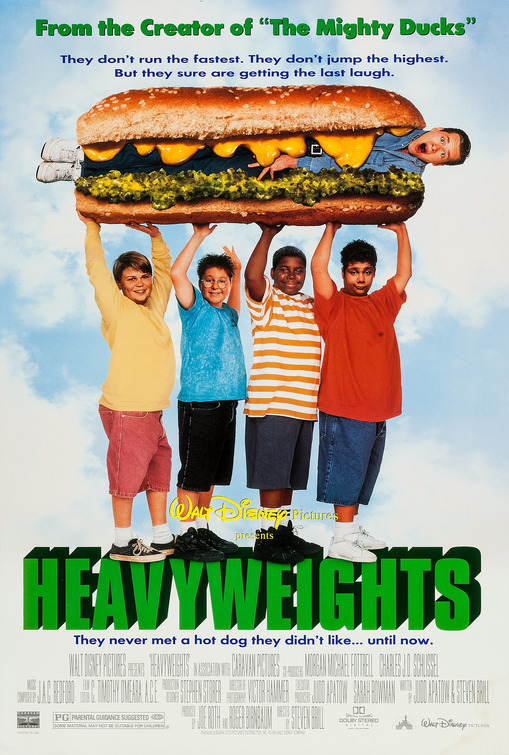
The rest of the staff, about 6 of us, drove into town to have dinner. We ended up at Pizza Hut, because no one wanted to take the time to find a real, local restaurant, which was mostly okay by me. We ate at the buffet, and I gorged myself almost sick. I think we all did. Which is funny, because there's a pretty common consensus that camp food is shockingly not bad, just disproportianatley (I have completely lost my ability to spell since I got here!) greasy and sugary, and veggies are mostly non-existent. Afterwards we killed some time at Wal-Mart (ah, small-town life!), then came back and watched Heavyweights, starring Ben Stiller and written by Judd Apatow, because it was filmed here in 1995. The camp owns a copy of it. It was kind of cool seeing camp everywhere, but the movie wasn't much good.

Yesterday I also learned how to kayak, and was the first time I've swam since I got here. Next time I kayak I'll try to get some pics; they also put up the "high ropes" course yesterday, and I guess they're going to start putting girls up on it tomorrow. I'm going to tackle that, too, because it looks awesome. And scary.

Yesterday in the gym I found an old, dusty copy of the first McSweeney's book, so I took it. That was exciting.

Yesterday, the Stranger in Seattle ran a feature on Homo History, featuring a short paragraph or two highlighting something significant from every year since the Stonewall riots in 1969. It features writers like Edmund White, Dan Savage, Andrew Sullivan, and others. It's pretty interesting, and features history just like I like it: in bite-size morsels.

Sunday, May 27, 2007

28 Weeks Later


To accuse 28 Weeks Later of being anti-American, as some people seem to have done recently, I think is a total misrepresentation. It's a simplistic, and in my opinion, deliberately cynical interpretation, as if you're desperately trying to see something that isn't there. It's like saying Swingers has a subtextual homosexual agenda because it's about men.

In every way 28 Weeks Later works. It's terrifying, heart-wrenching, and has not so subtle political overtones. If anything, though, it seems to me that the filmmaker's sympathies lie with the Americans. Obviously the metaphor is about American occupation of Middle Eastern countries where we may or may not belong. But the American soldiers are all portrayed as decent people desperately trying to do the right thing in a royally fucked up situation where reality constantly encroaches upon the best laid plans. In fact, the two main heroes of the film are both American soldiers selflessly putting themselves at risk to save the lives of others.

If the film could be read as anti-American in any way, possibly it comes in the form of faceless leadership that gives drastic and irreversible orders to the soldiers to carry out lethal attacks against citizens. But in the context of the film it's impossible for the soldiers to sort the innocent from the guilty and the killing comes with heavy hearts and an attempt to save the innocent in whatever way they can. It's a panic and lose-lose situation where stopping to consider consequences will result in it being too late to save anyone at all.

It's painful and horrifying to watch and perhaps offers a small glimpse into the confusion and existential horror many U.S. soldiers might face around the globe right now. Obviously they're not fighting flesh-eating zombies but that's why it's a metaphor.