The other night Kurt asked me if working at a hospice made me think about my own mortality all the time, and if that was disturbing at all. I didn't really respond at the time, but I would have to say that no, it doesn't. As someone who already thought (thinks) a great deal about my own mortality, I would have to say that if anything, it helps. It helps me to focus more on the here and now, I think, to worry less about everything I'm doing, and what the future ramifications will be. Living in the future has always been somewhat of a problem for me, and it's caused me untold amounts of anxiety. Travis once told me that I was an ideal candidate for religion. It's also created an almost intolerable impatience in me. One thing we were just starting to focus on in my therapy awhile back right before I quit going was to learn how I can further appreciate, not just tolerate, the here and now. How to live in the moment without always worrying about getting to the next point. How to just feel, and breathe, and relax, and enjoy each day for what it was. It sounds corny, but it's really hard for me to do. I have some theories about why I am this way, but I'll save those for another day.
As I mentioned a few months ago, we studied
existentialism in my Counseling class this semester. Pretty much all modern psychology, and more specifically therapy, is derived from an existentialist philosophy. Welll, most
humanism anyway, as humanism was a direct rebellion against Freud's
psychoanalysis, which is very negative and deterministic and essentially posits that we're all just slaves to our pasts. But the basic tenets of existentialism are free will, responsibility, and death. It's about living each day to the fullest; realizing that every single thing we do, even breathing, is done by choice; that we live our lives with the specter of death looming over us, and it's our responsibility to acknowledge that and honor it. The existentialists said that death is what makes life meaningful. We should acknowldege the past, but pay more attention to what we do today. We shouldn't discount the influence that the past has had on us, but we're not slaves to it, and the here and now, and how we treat each day, in the moment, is what's important.
Obviously, this philosophy appealed to me very, very much. It's also the direct basis for
cognitive behavioral therapy, which is precisely what I intend to practice, and frankly, what most therapists practice.
It wasn't until much later, though, that something really clicked in my brain: the reason that I loved
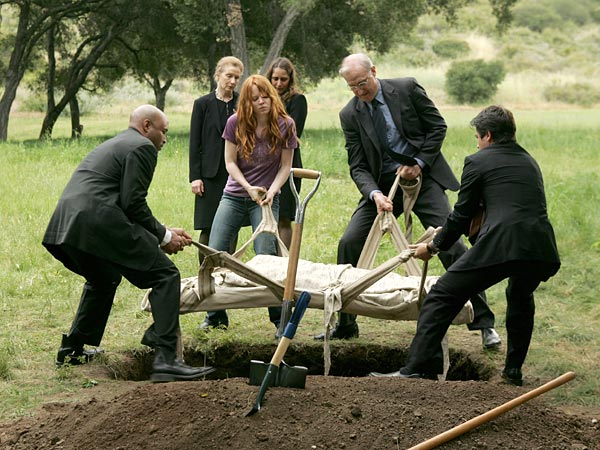
Six Feet Under so much was because it was a narrative explanation of existentialism! I love it when those neurons in your brain fire off at just the right moment, and things coalesce in a really exciting way. Of course
Six Feet Under is about existentalism, it's about death and acknowledging the responsibility you have for being alive! Every single episode is a lesson in existentalism.
Which reminded me of a
fantastic essay I found last summer, in the National Review of all places, about how great
Six Feet Under is. The writer, Radley Balko, makes much the same point, without actually calling it existentalism. Basically, he's praising the show for not taking a stand on abortion, one way or another, which is an issue that figures pretty prominently into the show in a few places, even though it openly promotes liberal values:
The show's critical acclaim and awards are well-deserved. The characters are wonderfully flawed and complicated, made all the more interesting by the backdrop of death: They face same decisions the rest of us do with respect to relationships, friendships, sex, and family, but they carry out their day-to-day lives just a few steps from the inevitably of mortality carried out almost daily in their home. Each episode opens with a death vignette, usually someone unrelated to the show's main characters, but who eventually becomes a Fisher "client," and whose life, death or grieving relatives somehow color and underscore the ensuing episode's themes.
If you have seen the show, you might be curious why National Review Online would publish a piece by a libertarian singing its praises. There are, after all, a number of openly gay characters and plotlines. Drug use abounds, copiously and unapologetically. There is rampant promiscuity, and enough purple language to blush a sailor. Family hour, it isn't.He goes on to discuss the show's take, or non-take, on abortion, which is an issue that comes up at least twice in a major plot points:
But there's something else about the show that I've found surprising, and that should hold some appeal for conservatives. Alan Ball and his team of writers have shown a courageous willingness to challenge Hollywood orthodoxy on the subject of prenatal life, on the moral absolute of abortion rights, and on the soul-carrying capacity of a fetus. It's probably a stretch to say the show is "pro-life," or even "anti-abortion," but it has at least been sympathetic to the idea that abortion is more than a mere personal choice rooted in identity politics — that it is a very real decision with very real consequences, and perhaps for parties other than just the woman who chooses to get one.I'm not exactly sure why he thinks Hollywood is so orthodox on the subject of abortion, as even one conservative once admitted, even the uber-liberal ladies of
Sex and the City couldn't go through with an abortion on season 4, and Miranda ended up keeping the baby.
Anyway, he goes on to explain the situations for the abortions, and the ramifications for the characters involved, and the way the show deals with them. But ultimately, in both situations, the "drama," if you will, comes down to the characters involved having to face up to it and take responsibility. Or not.
...within that framework, Six Feet Under is in many ways one of the most morally instructive dramas on television. It's rich with human frailty and failure, one of the many reasons why it's so watchable and authentic.
But the show refuses to punish its characters for human failures, the kinds of lapses in judgment and temporary faults we're all guilty of from time to time, the kind that make us mortal. It's only when they refuse to take responsibility for those mistakes that Six Feet Under's writers discipline their characters, often brutally.And about that, he is correct. So without even knowing it, Balko has argued for the legitimacy of existentialism, and how it only makes sense as a healthy and fit way to live life. Free will, responsibility, and death. Own it, and learn how to live as richly and fully as possible. I'm doing my best to figure out how to do that, and put it in practice. So far, I'm not doing a horribly good job, but knowing is half the battle, right? Right?






 I've always heard he was a big crackhead.