Showing posts with label Therapy. Show all posts

Friday, June 13, 2008

Old habits die hard


Some people say that in relationships, timing is everything, above all else. I don't completely believe this, but I don't disbelieve it, either. We bring to every relationship we form the sum of all of our experience, along with our current situations. And if we can't imagine our lives having turned out any differently than they are now, most likely it all has to do with one or two decisions we made, perhaps haphazardly or impuslvely, a long time ago.

Which is why "fate" is bullshit. Any of our lives could just as easily have gone a totally different direction if we hadn't ask that person for their phone number, or moved to a different city, or not gone out for drinks one night. It's sort of too overwhelming to think about, but it's something I tend to obssess about. Rather needlessly, of course.

Some very close friends of mine that I respect 100% recently undertook the viewing of Six Feet Under.

Anyone who knows me at all knows that SFU is kind of like my religion. It is what allowed me to be born again. I'll spare you the details (of course, if you've been reading this blog for the past 3 years, you already know the details....), but suffice to say, SFU pretty much ranks right up there with being born as one of the greatest things that ever happened to me. It literally changed my life: it opened up a whole new world to me, and totally altered my philosophy.

But I was also in the deepest, darkest trenches of emotional warfare at the time, fighting a losing battle against enemy insurgents in my brain that wanted to kill me. And SFU was a revelation. Why it was a revelation is too much to get into at the moment, but it was.

And the thing about my friends watching the show is this: they don't really care for it. I haven't discussed it in detail with them because I'm a coward and don't have the stamina for it (and I wouldn't want to put words in their mouths anyway), but I think they find it silly, pretentious and maybe slightly laughable.

Hmmm.

I know I'm overanalyzing here (surprise!), but if they see so very little of what I see when I watch that show, then what can that possibly mean?

Probably very little, actually. It's a fucking TV show.

But it's my TV show!!! It's what inspired me to change my life and become a therapist and go back to school. Hell, it even inspired me to practice a particular kind of therapy.

But maybe....just maybe....

If I saw the show now for the first time, assuming that my life were still in the same place it is now, would it still mean as much to me?

Hard to say, but probably not. I bet I would still like it a whole lot, though. When you find something (or someone) that speaks to you so profoundly, it's impossible to separate that from the circumstances or history.

It just is, it just does. So I can't hardly blame my friends for not seeing in Six Feet Under the same magic that I did: our lives and situations while watching it couldn't be more different. There's nothing more to be read into it than that.

Of course, I still think they're wrong and I still find it disappointing, but there is no deeper meaning than that.

A relationship with a TV show, or any piece of art, can be as complicated (or as simple) as any relationship with a person. It all depends on where you are, where you've been, and where you're going.

Plain as that.

Saturday, April 19, 2008

Moldy

Right now I'm eating a peanut butter sandwich on expensive bread that I bought quite awhile ago and never ate, and I can't decide if the white powder is flour or mold. The expiration date was 4 days ago. I'm also having a glass of milk from a $5 gallon of organic milk that I've only had about half of, and it expires tomorrow. The milk also tastes a little sour. My cat is stalking invisible bugs on my rug.

I can't help but feel all of this is a metaphor for my life.

Today as my cleaning expedition continued I came across a whole cache of notebooks. Some were from school, some were half-hearted journals with, like, 2 pages written in them. One was a dream journal I actually bothered to keep for about an hour. That was fun to read, and I did recall having those dreams as I read about them. But I came across a single sheet of paper I remember filling out, but not why I was filling it out. Was it for school, for therapy?

Not sure.

Anyway, it had some questions, and some answers put down by myself.

Question 1: Best part of being in love?
My response: Realizing that there are people out there I can connect with.

Question 2: Worst part of being in love?
My response: insecurity.

Question 3: What do you let slide?
My response: Indifference.

Question 4: How do you stop taking care of yourself?
My response: I put his emotional needs before mine.

Question 5: Survival Mechanisms?
My responses: ignoring hurts; submitting; making excuses.

Gawd! How depressing. At least I've moved beyond that mind-set a bit, if only a bit. It's funny how your last relationship seems to shape and form every relationship you've ever had (or will ever have!), and suddenly the dynamic of that relationship seems to be the model for all of them. At least until the next one comes along.

Never mind that maybe your dysfunction was just a function of that particular relationship, and his inability to communicate. Or express feelings. Or act remotely interested in anything you had to say. Or be nice.

Yeah, thank God I've moved beyond that. I guess sometimes you have to realize how badly you're being treated by someone you're in love with to realize how well you believe you deserve to be treated.

Tonight I found some little trinket, bead-like things on my windowsill that I've never seen before. I've lived in this room for almost 2 years. They're square and metal and have letters engraved on them.

Weird.

Tuesday, January 29, 2008

But we're not supposed to be happy...are we?

The other day at work, one of my co-workers told me I was hateful and bitter, to which I laughed heartily. She actually is one of my favorite co-workers and we get along really well, and she was mostly teasing me, but I think there was some truth in her condemnation. Then the other day she asked me if I considered myself a happy person. When I asked her why she was asking, she told me she found it disturbing how miserable and bitter so many of the people that worked there seemed to be. And since she considered herself to be mostly pretty happy, and since so many of the people that work there are so young, she just wondered why so many people seemed so unhappy.

Aside from the fact that I think working retail just brings that out of you (particularly where we work, where it's pretty much written in the rule book that customers are allowed to abuse you however they see fit, because a sense of entitlement is something the company wants to foster among the customers), I also think sometimes that's a byproduct of being young. As one gets older, I think maybe they learn to appreciate the small things more. After a certain age, I think people start getting broken down into accepting that mostly everything sucks and that's just the way it is, so they stop expecting things to be different, which is what causes so much misery among the young and idealistic.

Well, okay, maybe that's the just case with me. Once I realized that pretty much nothing works out the way you want it to, that relationships are always gonna fall apart, that most things are gonna hurt, that anything worth having takes an enormous struggle, and that nobody owes you shit, I was much happier. Or, at the very least, I kind of stopped having expectations. Which in turn made me happier. Or more accepting. I stopped fighting so much. As my mother told me after my last wretched breakup when I was crying on the phone to her, I had to learn to accept things as they are, and stop trying to force everything all the time.

All of which is to say, even though I haven't yet read the book, this guy might be my new hero.

He's mentioned in an article on Salon this morning about the quiet rebellion of psychologists and therapists against our pill-crazed culture.

To that end, Eric Wilson's "Against Happiness: In Praise of Melancholy" is a loopy, feeble blow against the empire. The new book is a heartfelt defense of being bummed out. The chairman of the Wake Forest University English department, Wilson is Hamlet-mad for sadness. He extols depression the way 19th-century aesthetes swooned over tuberculosis because it made them fashionably pale and broody.

Life means pain and death, Wilson repeatedly reminds us, and we must embrace these to find our "sorrowful joy." But most people are too harried and hollow to grasp this, too distracted by happy pills and shopping malls. We've probably never taken the time to walk through "autumn's multihued lustrousness ... with hearts irreparably ripped." Nor have we "stared for an hour at the sparrow lying stiff on the soiled snow."


I was on antidepressants once, briefly, and they helped me tremendously, but it wasn't the kind of help I needed. I could get out of bed in the morning; I could hold down a job and still get good grades at school; I could go out with my friends and laugh and have a good time and be engaged; I could still take care of myself and eat right and shave. I also didn't realize they helped so much until I stopped taking them, and then started feeling like hell again and not sleeping. But what I didn't need was a pill; what I needed was to learn adequate methods of handling my emotions so they didn't feel so fucking overwhelming to me. I'm a lot better now than I used to be, but I still sometimes feel myself facing the options of either being totally overwhelmed, or just shutting down. Lately I've been finding it much easier to shut down. When I really need to feel something, I go to bed.

One unintended consequence of defining depression downward has been an inability to distinguish -- with any accuracy -- severe depression from garden-variety glumness. Drug companies and doctors started a cascade, a blurring of categories between depression and anxiety, anger, laziness or low self-esteem. Treating them represented a huge market expansion into "lifestyle issues." As a result, millions of people have been prescribed pills -- that is, treated as if they were ill -- when they were just feeling, well, sad.


I'm glad the Salon article goes on to extol the virtues of CBT (Cognitive Behavioral Therapy), and the statistics that it works (reports as high a success rate with clients) as well as taking antidepressants. But yes, it takes time, and it's painful, two things Americans are vastly opposed to as a group.

Ironically, it was CBT that really enabled me to grasp that concept, to love my pain and misery and welcome it whenever it knocked. I haven't been the most gracious host, admittedly, but I know what I need to do, and that's half the battle, right? I'm trying. My misery and I have formed a tenuous friendship, a light give-and-take, that sometimes is kind of comforting in a twisted way.

Sunday, December 16, 2007

buzzes like a fridge


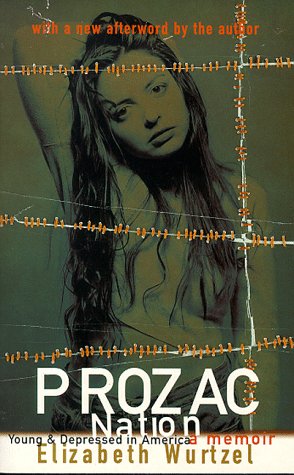
I started reading Prozac Nation by Elizabeth Wurtzel this week, for the second time. Not because I thought it was so great the first time I read it, but because of the opposite. I was 18, in my freshman year of college, and I just didn't get it. I totally lost patience with it, despite plowing through it, and thought it was the whiniest, most self-absorbed piece of tripe I'd ever read. More than once, I wanted to throw the book across the room, and scream, "Get over yourself!!" So when I saw it on a friend's bookshelf this week, I decided to give it another chance, with 12 years and a whole hell of a lot of life experience to bring a new perspective to it.

Well, I still think it's a pretty terrible book. I still think it's whiny and self-absorbed, and the girl can't write particularly well, but it's definitely striking a different chord with me this time. This time, those things don't make me lose patience because I think I can relate to it a lot more. Not least the feeling that when you're depressed, or when you think you're genuinely losing your marbles, you do become pretty self-absorbed, sometimes by necessity. I pick up on the wisdom a little more this time around, and think that she's got some pretty insightful things to say, not just about depression and hysteria, but about the way our society treats mental illness and the people who suffer from it.

One aspect I particularly enjoy is her juxtaposition of the way depression is viewed against the way drug abuse is viewed. Drug abuse is so tangible, it's so - for all intents and purposes - socially condoned and glamorized. Drug use is seen as something people need to be rescued from, that can be fixed. All manner of inappropriate, destructive, thoughtless, and dangerous behavior can be explained away in drug abuse, and as long as the abuser gets help eventually, generally it's all forgotten and chalked up to the drug. It's not the person's fault, it's the drug. As long as no one dies, it's live and let live.

But anyone who's depressed, or has any kind of personality disorder doesn't get the "get out of jail free" card that drug users get. When Wurtzel was a teenager, slashing up her legs with razors and taking overdoses of allergy medications at summer camp, she was told she had no reason to feel so bad, that all she needed was exercise and more socializing, and the problem was mostly ignored. But, she claims, if she'd been going to parties and snorting coke or shooting up heroin, her parents would have had her in the best treatment facility they could afford before the sun was up.

Drug abuse is seen as a disease, whereas personality disorders are seen as flaws. She even hypothesizes that maybe one reason so many people take so many drugs is not necessarily because they just want to be taking drugs, but because it's the only tangible way, short of a serious suicide attempt, to make people understand how awful they feel and that they might just need some serious help. See, if I take drugs, and engage in a slow but serious physical self-destruction, then maybe someone will take my pain seriously.

It's not an argument, I have to say, that I disagree with.

Just because people can hold their lives together, and keep a job, and do their schoolwork and pay their bills, doesn't mean they don't feel like they're crumbling on the inside. It doesn't mean that they're not still constantly filled with a despair so overwhelming that it feels like a physical presence upon, or within, their body, like a slow-growing cancer. Just because a person can get through the day without bursting into tears every time they actually feel like bursting into tears, doesn't mean that life doesn't fill them with an abject terror and sadness that never ceases, no matter what they do, or don't do. It just means they've learned to work around it, fit it into their schedule, fold it into their daily routine. Make it a part of who they are. Some people don't have the luxury of a total breakdown, and I guess in some people's eyes, if you can actually detach yourself from your life enough to say, Well, maybe if I have this breakdown this weekend, like I really want to, it will put my school career in jeopardy or push my poor mother over the edge, so I can't do it. I have to suck it up and keep going, no matter how impossible it may seem or feel, well then, you're not really that bad off.

But god forbid anyone should go out on weekends and do some blow, or need a drink in the morning to face the awful world and the aching dullness of their life.

Those are the people that have serious problems. And sometimes, they're the ones that get the help, often from the intervention of other people. Because it's physical.

Those other people, well, they just need to get some perspective, I guess.

Or so it goes.

Wednesday, July 25, 2007

Albert Ellis


Today marked the death of Albert Ellis, the man who, in 1957, officially founded cognitive behavioral therapy. He was 93.

A 1982 survey of clinical psychologists ranked Ellis as the second-most influential in the field -- ahead of Freud and behind Carl Rogers, founder of humanistic psychology.

Ellis, who was born in Pittsburgh and raised in New York, wrote or co-wrote more than 60 books, including "A Guide to Successful Marriage," "How to Live With a Neurotic" and "A New Guide to Rational Living."

After receiving a doctorate in clinical psychology from Columbia University, Ellis started a private practice specializing in sex and marriage therapy. R.E.B.T. grew out of his own experiences and the teachings of Greek, Roman and modern philosophers.

While Freud's school focused intensely on childhood and the unconscious to explain the source of neuroses, Ellis' brand of talk therapy asked patients to take immediate action to confront irrational thoughts.

His work, along with that of others including Dr. Aaron Beck, is considered the foundation of cognitive behavior therapy. Ellis was also known for his irreverent lecture style and salty language.


He is also the founder of the Albert Ellis Institute in New York, which is thriving today.

Wednesday, February 07, 2007

Beware this troubled world; control your intake.

One red pill. One fuckin' huge red pill. Or is it sort of orange-ish? I haven't actually taken any out of the wrapper yet. Maybe the wrapper is just red, and the pill will be some kind of washed-out beige color. Beige is bland. Beige is oatmeal. Beige is a multi-vitamin from Central Market that makes your urine turn neon.

But red. A red pill is serious. Fire-engine red. Red is danger. Red is passion. Red is not. fucking around.

Every morning. With food. One big red fucking passionate pill.

8 am? Every morning? Why 8 am? That seems absurd. Why will it hurt to take it at 10? With my 4 daily eggs and orange juice and coffee.

Because they said so. 8 am. And they're doctors. So you have to listen to them. Well, except for Stacy. She's not a doctor, but she is working on her Ph.D. in Psychology. It's nice that they let her help with the psychiatric evaluation. Dr. Garcia I'm not so crazy about. Not incredibly affable for a psychiatrist. But here I've been sitting in this room for 45 fucking minutes waiting on him. I tried to turn on the radio to listen to Fresh Air, but it didn't work even though it was plugged in.

Not crazy. About him. Not crazy. I don't want to kill myself. I still have my sense of humor. No suicidal ideation.

No, no nightmares.

Yes, I have a still have a libido. Oh yes. The pill could reduce that. The big red fuckin' passionate pill could interfere with "sexual function." Hmm. That's something to consider. But that might not be so bad. It's not like I'm sleeping with anyone anyway.

Appetite? Yep. Although I do seem to have lost some weight. I wonder if that's due to the red meat I've been cutting down on and replacing with more yogurt, bananas and cantaloupe.

Nevertheless, I qualify. Acute generalized anxiety disorder with mild to moderate depression.

It's not healthy to ruminate. It's not healthy to be gripped by such panic at least once a day that you have to stop whatever you're doing and cry or go be alone, and if you can't you fly into such a murderous rage that you want to kill every person you see for at least an hour and you grind your teeth and your blood pressure goes up.

I'm not special.

It's called Being Alive.

At least I'm feeling something. I guess.

Who am I to feel this way? My life has been pretty charmed, considering. There have been some tragedies, some upsets, some tension. Nothing's perfect. And besides, that's got shit all to really do with it.

But it's in my lineage.

My grandfather suffered from debilitating depression for most of his life. He was a warm, sensitive, loving, wonderful man. I miss him dearly. But he could also be very cold, withdrawn, distant, tired. Blank. His eyes held a lot of pain.

His daughter, my aunt, my mom's sister, she died too young. The coroner was a family friend, so it was an "accident," but we all know what really happened. She practically held a degree in pharmaceuticals. She knew what she was doing.

And, well, there's the immediate family, which I won't even go into.

So what's one more?

That, in and of itself, is depressing. Elizabeth Wurtzel makes it seem glamorous. But it's not. It's fucking boring. At least I can get out of bed in the morning and don't try to kill myself at parties.

Blake Schwarzenbach, of Jawbreaker, once sang, "All I want is a life without parties." I know what he means.

William Styron said, "The shadows of nightfall seemed more somber, my mornings were less buoyant, walks in the woods became less zestful." He was saddled with a "fidgety restlessness" and "an immense and aching solitude."

In The Savage God A. Alvarez writes, "My life felt so cluttered and obstructed that I could hardly breathe. I inhabited a closed, concentrated world, airless and without exits. I doubt if any of this was noticeable socially: I was simply tenser, more nervous than usual, and I drank more. But underneath I was going a bit mad."

Can a big red fucking passionate pill give you Hope? Can it give you Faith that intellectually you believe in, but emotionally you don't? And I don't mean the religious variety. I just mean Faith in general. Faith in humanity. Faith in yourself. Faith in your future. (That's the hardest one.)

We'll see.

10 weeks. Then 3-6 months of free treatment, regardless of what happens with the pill.

It's a win-win-win situation.

I guess.

Wednesday, January 17, 2007

"It is up to you to be Lacanians if you wish; I will be Freudian."

Last night I just finished reading what was perhaps the most depressing, but also most fascinating, book I've ever read in my life: The Unsayable: The Hidden Language of Trauma by Annie Rogers, PH.D.

Miss Rogers is a psychotherapist who specializes in working with traumatized children in her practice. This means that she generally works with children who have been horribly abused somehow, usually sexually, and most of whom have then in turn acted out their abuse on other, smaller, more helpless children than themselves. She has worked with some boys in the past, but for this book, she focuses specifically on girls, and on her own abuse as a child at the hands of her depressive, alcoholic mother which caused her to lapse into psychotic and schizophrenic periods as an adolescent and young adult.

The book is divided up into quarters, the first and fourth quarter about the author's own struggle with mental illness, the second quarter focusing entirely on one case study of a girl named "Ellen" who was horribly abused by her older male babysitter for three years before she told her parents about it, and the third quarter about a series of girls in a mental hospital in Boston who are all there because they were abused in unimaginable ways and reacted violently to that abuse themselves by engaging in their own torture, rape and abuse of other children.

The stories in this book are indescribably awful, and at several times I had to just put it down for a few days and (somewhat begrudgingly) come back to it; it took me over three weeks to get through it. The cast studies are described with matter-of-fact details, and only occasionally does Dr. Rogers write about her own emotional reactions to any of it.

What's fascinating about this book, however, is the method that Dr. Rogers uses, which is a language referred to as "the unsayable." According to Rogers, who herself is working from a framework set forth by the French psychoanalyst Dr. Jacques Lacan, people, especially children, who have been through highly traumatic events in their lives, sometimes lasting over periods of several years, lose the ability to speak about it in everyday terms and language. In other words, what they've been through is so horrific that words fail them, and the human language (no matter the language) will never be able to live up to the task of conveying the true horror of what they've been through. So "the unsayable," in other words, is the language of the subconscious, that every single person on Earth speaks through in some form or another.

It's like the idea of subtext in a screenplay; the Unsayable is all about the patterns people speak in, the words they leave out, the repetitions they engage in, their physical behavior that betrays their inner life. What Dr. Rogers is trained to do is decipher this "language" in her young, damaged patients, to try to see through it, interpret it, and then parse out what it is, exactly, the girls are trying to get across to her. Or, alternately, what they're trying to hide, but unintentionally revealing anyway through all of the above. Many of the girls she worked with don't even remember years of their lives, such as the girl who was 12 or 13, started being abused around the age of 7, but has zero recollection of anything in her life between the ages of 7-11, when she attacked another child and was put into this home. Already a quarter of her life is missing from her consciousness! It's in there somewhere, obviously, and it's Dr. Rogers' job to pull it out, make it known to the girl, put it into a language and context she can make sense of and handle emotionally, and then work through. It's certainly not an easy job, and in the case of the girl who was abused by her babysitter for 3 years, Rogers worked with her for almost 10 years, at least once a week, often more often than that, to get to the heart of her own disturbing behavior.

The language of the Unsayable stems from Freud, originally, and I have to say, this book made me look at Freud through a whole new light. Rogers spends a few pages towards the end of the book lamenting how Freud has been hijacked by the mainstream and often made a joke of by people who don't really understand what he was really all about. To Freud, the subconscious is not really about what most people think it is. It's not about things that are buried, necessarily, and that you're not aware of. It's about things that are buried that are trying desperately to make themselves known to the consious mind through various avenues I've already mentioned. Rogers came back around to Freud through the French analyst Lacan, who himself was a Freudian, and did much work to advance understanding of this "unsayable" language of the unconscious.

Lacan himself describes it this way: "Freud's central insight was not [...] that the unconscious exists, but that it has structure, that this structure affects in innumerable ways what we say and do, and that in thus betraying itself it becomes accessible to analysis".

Hence, what is known as a "Freudian slip."

Lacan developed several phases that an unconscious develops, mirrored to Freud's own Oedipal crisis stages, like the Anal, Oral, Latent, etc. He expounds upon them, however, using his own language and interpretation, which is far too complex to go into here, but if you're interested, they are laid out in the above link.

Also in the last chapter of Rogers' book, she talks about a school she attended in Canada, the Freudian School of Quebec, which has had quite a lot of success in treating young psychotic adults who have been deemed untreatable, including severe schizophrenics who went on to have productive work lives and have honest to God relationships with people. People who wish to go through their own Lacanian psychoanalysis (and anyone can, as Rogers did) should expect a treatment of 8 to 9 years, but gets to the heart of what it means to become a professional analyst. According to Rogers:

What does it mean to become an analyst? It isn't about acquiring a piece of paper that gives you a title and it isn't about gaining a theoretical expertise, per se. It isn't about having a couch and sitting behind it. To be sure, it is a long process that may not lead you where you think you are going. Willy Apollon says, "We are not a school of analysts; we are a school of analysands." That's the heart of becoming an analyst: a long route through your own unconscious, and the courage that's required to experience anxiety and anguish as you face your own life's failures - before you sit behind a couch and pretend to be an analyst with someone else's suffering.

I know what she means. Even in the brief period that I was in therapy in 2005, it was intense and by far the most painful and unsettling experience I've ever had. And we'd barely even begun to scratch the surface. If you've ever been through this yourself, you can start to understand why psychotherapy really has such a low success rate. It's too excrutiating for most people to go through, even if you think you're ready. My therapist told me once that he's had clients that it took years of counseling to before they would get to the real reason they were there. Years! Imagine it. Now apply that same logic to a child, who has been through unspeakable circumstances and can't even begin to make sense of it, and what a painstaking process it must be to get to the heart of their trials and behavior.

Thank God for people like Annie Rogers. She's my new hero.

Friday, January 12, 2007

Novocaine for the soul

The professor for my Intro to Guidance and Counseling class this semester is a very soft-spoken middle-aged woman who wears cute sweaters and cuts her hair very short, and looks like she should be playing an organ in a suburban church somewhere in Iowa. She's very sweet, though, and I like her a lot.

Today we were talking about bringing our own values into therapy sessions with clients (assuming, of course, that we were all the therapists) and she told us a story about when she was in grad school. She didn't say where she went, but she said it was on the east coast, and was a very conservative religious institution. As a student, she had to enlist a student willing to undergo five sessions with her acting as the therapist to the student, and the student had to be willing to have the sessions recorded for later analyzation by my teacher's own professors at that time.

Anyway, she cajoled a young man she vaguely knew into doing it, who was suffering a fair amount of angst and anxiety after going through what he had said was a pretty rough breakup. They talked it out for five sessions, but throughout those five sessions, the student only referred to his other as "the person I broke up with." Over and over again he would say that, never supplying a name or any kind of real identity to the person. Naturally this discouraged my professor, so when the young man agreed to come back for a sixth session, without being recorded, in other words, with true confidentiality, my professor asked him if he would just humor her by providing a name, any name, to refer to his ex. So with some hesitation, the young man said, "My ex's name is David."

Several students in my class has already figured out that this is what was happening, and there were some nods and smiles of recognition. Anyway, my professor went on to say that she was stunned, and the first thing she wanted to do was stop everything and call her professor and ask what she should do. She said she'd never had any experience working with homosexuals, and had never even, to her knowledge, known any.

But she continued on with the session, doing her best to hide her discomfort. She said at that time that it would have been so easy for her to have said something to have severely damaged this man who was clearly already suffering a great deal, and even she wasn't sure what her values were in this case, and whether or not this was something she wanted to take on.

After that session, the man convinced her to take him on for another 6 sessions, unrecorded, just as client and therapist. She somewhat begrudgingly agreed to do so, but figured it would be an interesting way to challenge herself and perhaps try to figure out what her values really were. She also admitted that this could have really backfired and was pretty irresponsible of her; in other words, figure out your values first!

Long story short, she and this young man clicked really well and ended up forming a very intense and healthy therapist/client relationship, and the young man started telling all of his friends about her. "Pretty soon," she said, "I had every gay guy on campus coming to see me." My class erupted into laughter when she said this.

So, obviously, everything turned out well and she said she learned more than she could have imagined from this man. They lost touch, but she said that she wished she could find him now and tell him how much he changed her life and outlook.

I just thought that was a sweet story.

Saturday, September 09, 2006

Prologue (Beginnings)

The face of a lover is an unknown, precisely because it is invested with so much of oneself. It is a mystery, containing, like all mysteries, the possibility of torment.
James Baldwin


I started having panic attacks the summer I was 28; gripping, terrifying, wish-I-was-dead panic attacks. I’d always been a nervous person, and in the past year, my anxiety levels had increased exponentially, but this was something altogether new. This was something that seemed totally beyond my control, something that threatened my sanity, and maybe my very existence.

I was curled up on my bathroom floor in my underwear at three in the morning. I had to be at work at eight. I was sobbing, my stomach hurt, my head threatened to pound right through my skull, and none of it would stop. As soon as I thought I had a handle on my torrent of tears, they would start right back up again. My body was releasing years of pent-up frustration, rage, panic, repression, and fear. Like the levees in New Orleans that gave way that same summer, wrecking an entire city and countless lives, my own personal levees had held strong and done their job for the past 10 years, but after this last storm, they couldn’t hold anymore. They burst, and I had no idea how to handle the resulting flood.

These attacks of mine were becoming more frequent. This was before I discovered Xanax, and realized I could swallow one of those bad boys, along with a glass of wine and be as good as dead. Which is the way I liked it. I could lie on the couch and start watching TV after swallowing it, and within 10 minutes I would feel my arms start to go numb. I would try to lift them, to change the channel perhaps, or to take another gulp of my wine, but the effort would be too much, and I’d decide everything was just fine the way it was.

Everything was just fine the way it was.

I would no longer be able to control my eyes and decide it was time to curl up in my bed, the covers wrapped tightly around me, and just imagine that this was the End. I would literally have to lift my legs off the couch using my arms; they were that heavy and useless. I lived in a studio apartment, so my couch was only about five feet from the bed, but nevertheless, once I stood up, I would inevitably fall down walking only that short distance. So I crawled to bed, and giggled a little bit.

I liked this; I liked this very, very much.

The drugs would not only numb my body and turn it to dead weight, but they would cloud my brain, so that I couldn’t form a coherent thought if I had to. This was what I wanted, this was the peace I’d been searching for, this was the rest of ages I’d been craving; all through the miracle of pharmaceuticals, with only the slightest bit of tweaking with alcohol. I could sleep for twelve to fourteen hours straight, and nothing would wake me up: not the phone, and only sometimes my alarm. I’d been a horribly light sleeper my entire life, and for the last few years, a very bad sleeper. Xanax gave me what I needed: deep, dreamless, immediate, peaceful, amazing sleep.

Of course, Xanax only masked the problem, it didn’t fix it. Without it, I was still a wreck, I still couldn’t sleep, and on those nights when I had to go without, the panic was even worse, because I anticipated it. I’d inevitably end up again on the bathroom floor, or punching the shower wall so hard that my knuckles would split open and I wouldn’t be able to type at work the next day. I would call people (at 1 or 2 am on a weeknight) and no one would answer.

Jesus, what if there was a fucking emergency? I’d think to myself. And then revise my thought: This is a fucking emergency!

I thought about killing myself. I thought about calling an ambulance and telling them I was dying, just so someone would come over and give me something to calm me down. I thought about putting myself in a state hospital so doctors would be forced to talk to me, and I could get lots of drugs. All I really wanted at that point was to be able to disappear, to not have to live my life, and slip into oblivion, but still be able to come back whenever I chose. But I couldn’t afford to go to a psychiatrist to get a prescription for Xanax, so I bought them, pill by pill, from a friend of mine who had a prescription. Or I traded her my Vicodin left over from my surgery that same summer, because Vicodin, sadly, did nothing for me. Even if I took three of them and chased them with whisky. Which I did. I think I had a faulty bottle. But my friend seemed to like them, so she was more than willing to trade up her Xanax. And then my Vicodin ran out, and then I panicked. And then my friend wasn’t as eager to share, even if I was paying her for the stuff, because she couldn’t get so many refills. I hated her for being so selfish and I was tempted to call her at 3 in the morning on a weeknight when I thought I was dying, but I didn’t. Because we weren’t that close, and it wasn’t her that I needed to hear from.

So the attacks continued. Not every night, but many nights, and even on the nights where I wouldn’t end up a sobbing, terrified, writhing disaster, I wouldn’t sleep. I’d toss and turn for an hour, two hours, get up, watch some TV, feel my eyes get heavy, go back to bed, and still not sleep. Most nights I would finally fall asleep around 4 or 5, just in time to get 2 or 3 hours of sleep before I had to be at work. I was a zombie during the day. I sat in the bathroom stall at work and sobbed. Once I ran into the bathroom with tears streaming down my cheeks, my heart threatening to beat right out of my chest and rip me in half, and my boss was standing at the sink, washing his hands. I hated him, and avoided him whenever possible, but today, he wanted to talk to me, and started some bullshit conversation about something I don’t recall. I answered a couple of his questions, with him pointedly ignoring my bloodshot eyes, and the stray tears, until finally I just turned and locked a stall door behind me and let it loose. I couldn’t have sucked it up if I’d wanted to. My emotions and their physiological manifestations were taking on a life of their own and turning against me.

What in God’s name was happening to me? I’d suffered pain before: knock the wind out of you, think-you’re-dying pain, but nothing like this. Nothing had so completely taken over and hijacked my entire life and emotional responses like this before, and threatened to derail every single thing I knew and believed in. I’d always been emotional, I’d always felt very deeply. I had no idea why now, at this juncture, I’d lost complete control. It was a certifiable nervous breakdown, and there was nothing I could do about it.

In the front of my mind, I thought it all had to do with a boy. A boy I was deeply in love with, a boy with whom, after a year-long relationship, I had broken up with. A boy I wanted to spend my life with, and about whom I had fantasies of building a life, starting a family, traveling the world, and with whom, I knew, ultimately, none of those things would happen. I blamed him for everything, I accused him of being immature, I flailed, I screamed, I cried, I begged, I manipulated, and still, he remained untouched and unmoving.

But I suspected there was more at play here. There was more than just having a broken, disappointed heart. I’d had a lot of broken hearts in my day, and none of them felt like this. None of them had induced this kind of panic, this kind of hopelessness, this kind of rage.

I started therapy with a counselor that I adored, but to whom I still couldn’t open up the way I needed to. I was guarded. I often just sat on his couch and giggled nervously, or blushed, or stared out the window, embarrassed. I avoided his most pointed questions by giving non-answers, or saying “I don’t know,” or laughing inappropriately.

I started finding other sources of Xanax. I started smoking pot on top of it, on top of alcohol. I really didn’t want to die, but I was pushing my limits, I was testing just how far I could push my body, how deep into sleep I could tumble, and still eventually wake up. I was deliberately tempting fate, and thus far, I was winning.

I didn’t want to die, but I don’t think I cared if I did. After all, I’d just be dead, what difference would it make to me?

One night, I’d finally had enough. I had no drugs, I’d already downed a quarter of a bottle of whiskey, it was three in the morning, and there I was, feeling it coming on again, that old familiar panic, the tightening in the chest, the racing heart. I screamed into my pillow, I used my own fist to punch myself in the side of the head to relieve the pressure, but it only hurt like hell and gave me a throbbing headache, which made me cry harder, which only frustrated me more. I was sweating, I was soaked, I couldn’t lie still in my bed.

When this happened to me, for some reason I usually gravitated to the bathroom. It was there that I would stare at my face in the mirror and spit on it. The face that, at 28, looked so fucking old and worn out to me already. I had bags under my eyes, with dark circles around them; I hadn’t shaved in days and it was growing in unevenly; I needed a haircut, my skin was dry; I had two cavities, that while remaining invisible, I knew were there, and just made me feel more disgusting, old, and like I was falling apart.

Tonight, I couldn’t do that. I couldn’t turn on the light in the bathroom, I couldn’t lie on the cold tile and beat my fist on the ground, or take another shower.

I crawled out of my bed, and for the first time since junior high, I kneeled at the foot of my bed, and I prayed. I prayed to a God that I barely believed in, and had no hope of actually being touched by. I begged God, if he was up there, to please take away my suffering, to please heal my loneliness, my desperation, to please help me make sense of what was happening to me. I’d never been so scared in my entire life, and if angels had appeared at my door to take me away that instant, I would have gone with them without a moment’s hesitation.

And then in therapy, something clicked, some things started to make sense. I started sensing a pattern of behavior. This was about more than just a boy and a broken heart. Much, much more.

I began diving into the deep, black heart of my repressed and tortured psyche. I start seeing things I didn’t want to see. I started understanding things that were far more painful and frightening than any broken heart. I started to understand how broken, incomplete and terrified I’d been for years, for my entire life, and could never acknowledge. I realized that rather than feeling so deeply, as I’d always thought, I’d barely felt anything at all, for almost 15 years. I was shut down, cut off and completely out of touch with my inner emotional life. I was a fraud and had everyone fooled; but now, I was starting to crack.

And it was all downhill from there.

Friday, June 02, 2006

Horse Therapy

I just got back from visiting the Centro de Rehabilitacion y Educacion de Infantiles with my professor. He wants us to start getting involved out in the community, and he had researched this place as a possible place for us to go help out. It's basically a school for developmentally disabled and retarded kids, run entirely by private funds, right in the center of Monterrey. So today he went to investigate, and it sounded interesting, so I thought I'd go along with him. Most of their kids they have in the morning (76!!), and then some in the afternoons, but it's much slower. Terry (my professor) and I got to actually help out in some of the therapy of this 12-year-old autistic boy who comes in there in the afternoons. They started him out on a horse, which they do everyday. He is led around, and as he's being led, he has to do mental exercises, like look at flashcards that we showed him, and after looking at 5 or 6, repeat back the order in which the objects on the cards were shown to him. And then he had different colored hula hoops we tossed at him, which he had to catch, and when he had caught them all, had to then place them on the different colored cones that we told him. Like, we would say, "Verde con azul," and he would have to drop the green hoop on the blue cone, etc. etc. You get the picture. So we did this stuff with him for about an hour. He was a really sweet kid, and only got upset once, at me, of course. I was walking next to the horse he was on, with a box of different colored pegs he had to put in a board to match a picture they'd just shown him (autistic people think in pictures, similarly to animals, actually; my professor was very impressed that I knew that), and I was supposed to hand him the amount and color of whatever peg he asked for, like cinqo amarillo (five yellows), and as you know, my Spanish isn't great, so I often couldn't understand what he wanted, and Terry and the therapist would forget to tell me what he was saying, so I wouldn't give him what he wanted, and he'd get mad. But all was well. It was really fun, actually. I guess I'm gonna start going back there next week in the afternoons for an hour or two. They told us to stop by anytime, but as a courtesy to them, I should figure out some kind of schedule. And talk other people into going with me.

After the kid was done with his therapy session, he went inside the school, and the therapist found out I was really scared of horses, so naturally, he made me get on it and ride around. I was very tense at first, and kept feeling like I was gonna fall off, but he kept telling me to relax, and eventually I did. Horse's heart rates are about the same as humans, and they give off a lot of heat, so there's all this theorizing that that's why humans bond so well with horses, because we sort of meld together, and it's very inherently relaxing. Which it was...once I relaxed. I haven't ridden a horse in probably close to 20 years, so it was nice to sort of get over that hurdle. My professor was joking on the drive back to campus that I got my own therapy. Which I guess I did.

So that's pretty much been my day. I think I'm going to switch out of my Spanish class at 11, into one that's at 9, mostly because the fucking Baylor frat boys are in my class, and I just really can't tolerate it much longer. They're so obnoxious, and it makes the class kind of chaotic, and the teacher won't do much about it, and it's really starting to piss me off. I didn't pay $3,000 to come to Mexico to get pissed off and intimidated by fucking asshole idiot jocks in class every morning. I just don't get it. Who are these people and where do they come from? I hope some horrible fate befalls each and every one of them to force them into some kind of humility.

Tomorrow I'm going here for the whole day, and I couldn't be more excited about it. But right now I'm going to grab some grub somewhere, and then go drinking with my professor and some 40-something-year-old friend of his. Should be interesting.

Wednesday, February 01, 2006

Don't Look Now

Has anyone ever had the kind of nightmare where nothing actually happens, but it's infused with such a sense of dread and foreboding that you wake up with your heart racing, and absolutely paralyzed with fear?

I can't even begin to really get into what exactly was going on in the dream, or what all the symbolism must mean, except to say that it all seems to have a lot of echoes of my past. It started out with my being all alone in Dallas, downtown somewhere, at night, and there was a serial killer in the area that hadn't yet been caught. It was some kind of dwarf who would break into children's rooms and cut up their faces and throats with a scalpel. And while this didn't happen in the dream, I was aware of its happening, and I was terrified and lost, and I don't remember what I was doing there.

Then it shifted to my childhood bedroom I had until I was 15. I was the age I am now, and sleeping in it, and wondering why, and the door was shut, and I could see, through the light at the bottom of the door, footsteps, and I just knew that it was the weird dwarf/monster thing, having come to kill me, and I was wondering why my parents weren't saving me, and why, being almost 30-years-old, I couldn't get out of bed and save myself.

Then I woke up, and it was still dark and I was short of breath, and almost felt like I was having a panic attack.

Very weird. It's times like these I wish I was still going to therapy.

Tuesday, January 31, 2006

Getting my soul in order

I've started to locate a lot of areas in my life that cause me very specific anxiety, and ways that I can start fixing them. Paying my bills on time. I always avoid opening bills because I find the whole act of doing that, and paying them, horribly depressing, so I just don't. But then they become late, and I wrack up fees, and creditors call me, and this causes me untold amounts of stress and depression, and it's all my fault, and if I would just pay my fucking bills on time, when I get them, this would never happen. And I wouldn't have to spend nearly as much money. duh.

So yesterday I bit the bullet and paid off everything I owe, including this super lame-o $103 fee to Time Warner Cable that I was just going to ignore since I no longer have Time Warner Cable, but I wanted to get them off my back. So now my bank account is significantly less (I had several issues pending), but I felt much better about it all, and I'm totally caught up on everything now. It feels nice.

I've also discovered that while I used to find television comforting (as some kind of "companionship," or portal to the outside world to fend off loneliness), that now I realize it depresses the hell out of me. Which I'm taking as a sign of maturity. I can sit in my living room and listen to music and do absolutely nothing, and feel less lonely than if I'm watching TV. And frankly, I find it very comforting that I feel this way. The passivity of it, I think, is what I find so bothersome. And the constant yammering of commercials and stupid people and laugh tracks.

I started reading The Art of Loving, by Erich Fromme yesterday, who was a very prominent psychologist in the 50's and 60's (very Christian-based and homophobic, too, but he was otherwise very intelligent, and everybody was homophobic in the 50's), and he talks a lot about love being an "activity, in the modern usage of the word...usually meant to bring about a change in an existing situation by means of an expenditure of energy." But then he goes on to talk about a man "driven to incessant work by a sense of deep insecurity and loneliness" actually being quite "passive," because he is a slave of his passion, and "his activity is in reality a 'passivity' because he is driven; he is the sufferer, not the 'actor.'" But then he goes on to say that a man sitting, doing nothing but meditating quietly and contemplating "with no purpose or aim except that of experiencing himself and his oneness with the world, is considered to be 'passive'...in reality, this attitude of concentrated meditation is the highest activity there is, an activity of the soul, which is possible only under the condition of inner freedom and independence." and on and on.

I thought this passage was particularly interesting because one thing my therapist and I dealt with quite a bit was my inability to be "in the moment," most of the time, and feeling like I always had to be looking to the future, or some pie-in-the-sky goal or whatever. I could never (and still can't, really, but I'm working on it) just take things day by day, or even moment by moment. Like, it's hard for me to sit still in a relationship and just enjoy it, or the moment, because I always want to know what's coming next, what everything "means," or why something is, or isn't, happening. I love it when I can read something like Fromme and immediately apply it to my life, and understand their wisdom and where they're coming from and what they're talking about. My constant restlessness: a sign of inner turmoil and insecurity (in a nutshell). Powerful stuff.

I'm also loving Mahler's Symphony No. 6: Tragic these days. It's on pretty much constantly. It doesn't sound tragic. It sounds like sunshine. Maybe that's the tragedy.

Saturday, September 24, 2005

i have known love like a whore, from at least ten-thousand more

one thing therapy has done for me that's been great, and is also, probably, just a byproduct of becoming older and wiser, is helped me to realize that i can't control everything. i'm what i guess would be considered somewhat of a control freak, and if something happens in my life that i can't either subltely (sp?) or overtly manipulate to go the way that i want it to, i panic.

it's felt really good, actually, to be able to let go of that mindset. i've come to realize that it does virtually nothing but cause frustration and anxiety. i also have a horrible tendency to compare myself to other people and feel like i come up very short, not really keeping in mind that perhaps my time just hasn't come yet. it seems like wedding fever really is in the air (sigh), with no less than 5 couples that i'm fairly close to (some more than others) getting married in the next year. i'm very glad for all of them, because they all deserve it, but it also makes me realize how much my life is changing. i guess i've been braced for it for awhile, but i didn't expect it all to happen quite so suddenly. it's a wistful, bittersweet feeling, and i honestly think i would feel that way even if i were the one getting married. and here i am going back to school in january to get my bachelors degree. in some ways i feel like i'm degressing (is that even a word?), but i know i'm not. it's good for me, and something i really need to do, and i couldn't be more thrilled about my latest decision to pursue a degree in psychology and then a masters in counseling. as karen put it the other night, "all we ever do is sit around and analyze ourselves, and each other, and our relationships, so it makes sense you would decide you want to do that as a career." or something along those lines. well said, karen.

anyway, the hurricane did not hit us today as predicted; in fact, it did the opposite of hit us. it was about a hundred degrees and sunny as hell. lucky for all the ACL-goers, i guess, but i have to admit i was a bit disappointed. i was really hoping to get pounded by a big one. no pun intended. so collier and i went shopping, and i found what might be one of the greatest shirts ever created at Blue Velvet, for only $16. it's a red and blue plaid western-style shirt with gold, shiny thread and pearl snap buttons. it's beautiful and it actually fits me. it's very exciting. and luckily i found it, b/c my heart was broken at Service Menswear by a shirt that was 50% off and might be the greatest shirt i've ever seen, but they only had it in medium. it was brown with yellow pin-stripes, but then had a white collar with sort of water-color-looking yellow birds on it. it sounds stupid, but i would be the hottest guy in the world if i only owned it. story of my life.

Thursday, August 11, 2005

black-eyed

so, my septoplasty is tomorrow (my deviated septum surgery), and i'm so nervous, i'm literally trembling right now, and having trouble typing. i started doing some research on the internet earlier, about recovery and whatnot, and maybe that wasn't such a good idea.

it seems most people are fine, and up and back around within 2 or 3 days, but other people have horrible reactions to it, including vomiting up copious amounts of blood (apparently, you swallow more than a pint of it during the actual procedure!), deeply bruised black eyes that can last for a week or more, and lots and lots of dried up crusty boogers around your nose that keep appearing for about 2 weeks. i'm supposed to have some company to watch over me this weekend, and i'm starting to reconsider. i found several pictures, too, of some woman who went through it and had it all documented, and it wasn't pretty. i guess i just can't be beautiful all the time.

however, judging by what i've been learning in therapy, about letting people see the "ugly, messy" side of myself, maybe that's a good thing. being ugly on the outside as a metaphor for being emotionally vulnerable or something. anyway, it's totally freaking me out, and i'm sure i'll be fine, but me being who i am, i of course keep imagining all the most worst case scenarios playing out, including having the surgery not really take, or having my septum collapse again, and having to have it done a second time, which isn't unheard of. even my surgeon warned me that was a possibility.

but i know it's necessary, and i'll be so happy that i had it done, once i'm over everything. even if it means i can't show my face in public for 3 weeks, and i lose my job b/c i just don't go back b/c i feel so ugly and gross.

oh lord. i'm scared. but i'm sure i'll be fine. i just hope i don't projectile-spray blood and mucous all over kurt's car on the way home!

Thursday, August 04, 2005

lord, i hope this day is good

yesterday was a really tough day, but i think i made some good breakthroughs. i went to my pre-op for the surgery i was supposed to have tomorrow, and i was told i'm going to have to push it back a week due to the fact that i started taking st. johns wort a week ago, and you can't have anything like that in your system, b/c apparently it fucks up your blood pressure.

it's not a big deal to push it back a week, but i was so mentally prepared to finally get all of this over with in 2 days, and it was a really big letdown. it was all i could do to keep from breaking out into convulsing sobs sitting in the nurse's office. having people carve up the inside of your skull is really nerve-wracking, and i've been psyching myself up for this for years, essentially. i know it's going to be so worth it when it's all said and done, but it's really scary.

secondly, i called my mom on tuesday night and just cried and cried to her. it felt so great. i haven't cried to my mom or really just been totally emotionally honest with her about anything since i was a teenager. it felt really good. she's suffered so much the last decade or so, and i've never wanted to burden her all these years, but finally i was just like, "fuck it, she's my mom, that's her job." she's supposed to protect me, not the other way around. it made me feel a lot better, and i feel like maybe some fences between the 2 of us that have been up for years are finally starting to sag a little bit.

i had another horrible anxiety attack at work yesterday, too, after returning from my pre-op appointment. i went into the bathroom and just couldn't stop crying, and eventually just had to go home. my friend here at work went outside with me and we had a really good talk, and again, i was able to really let myself go and cry in front of her, and then mark came back from lunch and sat with us for a bit, too. i've had so much trouble in my life making myself vulnerable in front of other people. i've always felt like i had to be this pillar of impenetrable strength, and never let people see the sometimes ugly, messy, uncomfortable, unattractive side of myself, but i'm learning to start letting all of that go. i know that people will still love me, and won't think i'm this blubbering, crying mess of an idiot who can't handle life. that's kind of how i feel right now, but i know it's a stepping stone and i'll get through it.

the therapy that i've been going to has been really intense, and this is one of the major issues we're working on, and my poor little tiny brain is just getting so overwhelmed with all of it. it's incredibly painful and shocking to learn that the emotional maps you've made for yourself over a period of a lot of years (roughly about 13 years, in my case), that you've always relied on to get you through, are doing nothing but fucking you up and in the end, making your life and your relationships that much harder. so learning to face those things head-on and really tackle them in a meaningful and useful way is so terrifying, it's almost inconceivable. it's almost like, you start becoming this other, unfamiliar person and you don't even recognize yourself when you look in a mirror. especially if your face is red and blotchy and tear-streaked and feels like it's been stretched. it's not pretty. and i've only been to 5 sessions. the fun is just beginning.

and lastly, after i woke up from my 5-hour xanax-induced coma yesterday afternoon, i called joe. it was the first time we'd spoken in about 5 or 6 weeks, and it was pretty intense. but overall, it was wonderful. we had one of the deepest, most open and intimate conversations we've ever had in our entire relationship. and while i'm still totally reeling from our breakup, and just so confused by it all, and having a really hard time making sense of it, we both agreed that neither of us can, or want, to walk away from this. we're going to cautiously try to be friends, and i really hope it works out and doesn't backfire on either one of us somehow. he's so important to me, but we were never really friends, just lovers, basically, and i'd like to try to do that. and even if it fails, at least we'll both know we gave it our all. it's another way i'm trying out with coping, since the total cut-off of all contact doesn't seem to be working, maybe this will. we'll see.

sorry if this post today seems a bit personal and weepy. i think it's good to get this stuff out there, and i don't even know if anyone even ever reads this thing. but i read it, and it's really just for me.