Thursday, February 21, 2008

Tales of the Tyrant

I just finished reading Mark Bowden's profile of Saddam Hussein from 2002, in the New Kings of Nonfiction collection, edited by Ira Glass, that Tom got me for Christmas.

It's a really interesting piece, offering a lot of insight into Saddam, and considering the level of his power, it really drives home how humiliating his ultimate defeat must have been.

A few things I learned:

- He only slept 2 or 3 hours a night, and never in any of his 20 palaces, and always in secret beds. Sleeping meant that he would have had to have trusted someone else, and he didn't.

- All three meals of the day were prepared at all 20 of his palaces: security demanded that palaces from which he was absent at least keep up the appearance of his presence.

- Water is a symbol of wealth and power in the Middle East, so Saddam had it everywhere, including in elaborate pools at each palace, which are all tested hourly for temperature, chlorine and pH levels, as well as for any poison.

- Since he ruled by fear, he could never seem to age to his population. Great pains were made to make him seem ageless, including dying his hair, never being seen with his reading glasses on, having his speeches written in huge letter for teleprompters when he gave them, and since he had a slight limp, never being seen walking for more than a few feet. Occasionally he would go walk among the neighborhoods of Baghdad, but always surrounded by security, and if anyone got close, they would be severly beaten.

- All of his food was flown in for him twice a week and sent to nuclear scientists who tested each shipment for radiation and poison.

- He was a writer who, among other things, wrote 2 romantic fables about lonely kings isolated from their kingdoms behind walls and guards. Apparently they're terrible, and were published under "Anonymous," but no one ever dared tell him they were bad.

- His favorite writer was Ernest Hemingway.

- He had a tattoo of 3 dots on his right hand, signifying his tribal roots and humble origins. Despite claiming to be a direct descendant of Muhammad, he never had the tattoo removed or tried to hide it like many people do/did.

- A hand-lettered 600-page copy of the Koran written entirely in Saddam's blood was, until recently one assumes, on display in a Baghdad museum. He donated the blood a pint at a time over 3 years.

- His two favorite movies were The Old Man and the Sea and The Godfather.

- In 1987, Saddam's army was the 4th largest in the world.

- One of his pet projects that he wanted to build for years, but never had the money to, was a world-class subway system for Baghdad, and then a multi-billion dollar nationwide rail system.

- In the early 1980's, several aides in the Iraqi ministry were accused of accepting bribes, so they were hanged. But they were also hanged in front of all of their friends and colleagues who were forced to attend, and nominally participate in, the executions, or be hanged themselves.

- Anyone in Saddam's circle overheard speaking ill of him would not only be executed, but have his tongue cut out beforehand. In his 3rd and 4th years of rule, Saddam executed over 4,000 people.

- Saddam's son Uday had a torture chamber in the basement of the Olympic Building where tortured and sometimes killed athletes (and their trainers) who didn't perform well, or made Iraq look bad.

- Typically, anyone that Saddam assassinated, he would either also assassinate their family or just their children, or, barring that, he would have the family's home bulldozed so they would have to be homeless.

- Apparently he had a pretty light and silly sense of humor and enjoyed not only telling, but animatedly acting out, funny stories, and was actually quite funny.

Tuesday, February 19, 2008

Fewer Parking Lots = More Density

Two new major downtown Austin projects were announced this week, both of which will replace space-wasting and ugly, empty swaths of concrete space, otherwise known as parking lots.

The first is the 18-storyWestin Hotel to go in on the former location of The Bitter End and the giant parking lot next to it on 3rd and Colorado. The hotel will feature a street-level restaurant and a 3rd floor bar overlooking Colorado.

The second is the Austin Museum of Art high-rise, combining a 40,000 square foot museum facility, along with 425,000 square feet of office space. It will go in what is now the gigantic parking lot at 4th aand Guadalupe, directly north of the new AMLI tower, and south of Republic Square Park where all the homeless people hang out.

AMOA is a little less than dazzling in its current state, so this is exciting to me. It's supposed to be complete by 2011. Here is an image:

Monday, February 18, 2008

Excuse me if I'm grumpy today. I haven't slept in over 30 hours....

After a very long day yesterday starting at 8am, working on my thesis for about 5 hours, then going to a very busy and shitty shift at work, I came home, ate a little something, had a nice glass of wine, blogged a bit, read a bit, and was in bed before midnight, barely able to keep my eyes open.

Anybody wanna guess what time I finally got to sleep?

...


Wait for it.....


....Around 6am this morning. And I had to get back up at 8.

Insomnia of this type is a special kind of hell. And the worst part is that whenever I got up to do something to distract myself, like read some more, watch really boring TV (and I can tell you that at 3 or 4 in the morning, there ain't shit on TV), count as high as I can, walk around the dark house without turning on any lights and stare out the window at the street for 20 minutes, I would find myself yawning, feeling my eyes grow heavy and my body weary, but as soon as I would lay back down in bed - boom.

Wide awake again.

All I have to say is that I better sleep tonight.

Sunday, February 17, 2008

Does anybody have a long, pretty wig I can borrow?

Back in the day, oh, in my late teens and early twenties, I used to reject the "gay" label, often quoting Michael Stipe, saying "Labels are for soup cans." I will love who I love, I said. I will love the person, not the body. Of course, back then, that was all just an elaborate charade so as to not have to admit that I was actually a homosexual, although I wasn't fooling anybody. Well, except maybe myself. Or, no, not really even myself. It was a safe way for me to admit that yeah, I was pretty queer, but not gay, not so compartmentalized, so scripted. I didn't know anyone yet who actually called themself "gay." I certainly wasn't brave enough to be the first. And as far as Michael Stipe goes, it was also a cowardly way for him to avoid the question.

Once, however, I became comfortable with the gay label, my next targets of my internalized homphobia were drag queens and transsexuals. I hated them, and Dallas nightclubs were full of them, even the non-gay ones. I resented that whenever I went to a gay club they were all over the place. They were (or maybe still are) a ubiquitous part of Dallas nightlife. At least where I went. Not until years later, when my boyfriend left me for a woman, and I had to face my own self-loathing and homophobia and fear head-on, did I come to realize that, even into my mid-twenties, being gay, to me, meant not being a man. It meant cutting off a part of your masculinity (so to speak). This was also why, for years, the biggest objects of my affection and unrequited love were always straight men. I don't know that I really wanted to date any of them (although a few of them I certainly wouldn't have kicked out of bed); I wanted to be them. I wanted to live vicariously through them. The acceptance of straight males still means a lot to me, even now. A large part of that, though, is also because growing up I never had male friends, and I always longed for them desperately. Boys always hated me, and, well, I usually wasn't ever too crazy about them either. I never had solid, close, male relationships until my early 20's. But I always wanted them, as far back as I can remember.

Luckily, and thankfully, I've moved on from all of that. (Isn't self-awareness wonderful?!?) All of which, ironically, has had me thinking about labels again recently.

In my Sexuality class a couple of weeks ago, we had a male-to-female transsexual come talk to the class about her experiences as a transgendered person, and how she came to decide to switch genders and live fully as a woman. It was fascinating, and since transsexuals are people I've taken an avid interest in recently, but never really had the fortune to sit down and talk to, I could have listened to her talk all day. It didn't help that she was a great speaker, was really funny, and had a charismatic comfort that radiated all over the classroom. Her journey was so interesting, though, and she said that her ideal man would be the totally stereotypical sort of blue-coller tough guy. Those guys, however, she lamented, were never interested in her. Freaked them out too much.

One thing I guess I'd never really considered a whole lot before her talk, though, was how identifying with one gender or another, just like sexuality, can be on a scale, just like sexual orientation (and I don't have to say that the two are totally unrelated at this point, do I....?).

One of the very best compliments I've ever received in my life came from a dear friend who told me that his favorite thing about me was that I encompassed the best of both genders. It was totally out of left field, but I've thought about that a lot since he told me that. It is true that I love being a man; I love my body (as in, the maleness of it, not my physique; I actually sort of hate that), I love being around other men, I love men's clothes, the way they smell, the whole bit. Inside, though, I've always felt much more feminine than masculine. In fact, and this is weird, but when I think of myself outwardly, like when I imagine what I must look like to others, I often imagine myself as a physical female. That's a hard thing to admit, and it's sort of scary, but I welcome in the anxiety. I'm fairly certain I'll never get to the point where I feel incomplete unless I'm a female; as I said, I do love being a man.

But having said that, I like to think of myself more as "queer" now than "gay." I know it doesn't really matter, and I still am what I am, but queer can mean so many things. Like, almost all of my heterosexual male friends I would also consider about as queer as can be. Just because they sleep with girls doesn't make them less queer than I am. (Sorry, guys, I hope you appreciate that!) It just means they're queer in different ways. At least in my interpretation.

A few weeks ago I wrote about needing to do something for my paper in my Sexuality class. Well, if you haven't figured it out yet, I have: I'm going to do a photo-essay of myself - in full on drag. I'm gonna go all out, with leg-shaving, high heels, a long wig, makeup, skirts. I think it will be a lot of fun, and yes, it does freak me out some. What if I really love it?!? Frankly, I don't really want to be a transgendered person, but I guess if I do love it and I am, then so be it. I kind of already consider myself about half transgendered anyway, I suppose.

Maybe I'll even post some of the pictures here.

Sunday, February 10, 2008

Suburban Decay


The latest issue of the Atlantic has an article about what will most likely become America's next major crime-ridden slum: the suburb. It's not an entirely new theory, and if you look at the patterns and data, it makes sense.

Arthur C. Nelson, director of the Metropolitan Institute at Virginia Tech, forecasts a likely surplus of 22 million large-lot homes in the United States by 2025. Foreclosure rates in 2005 and 2006 have been highest in suburban and exurban areas, with crime increasing in some of the harder-hit neighborhoods by 33 percent.

As more and more Americans, especially wealthy ones, start converging back upon the urban core that they all abandoned in the 1980's, property values are going to sink in suburban neighborhoods, along with tax revenue, which is highly dependent on house values and new development. 66% of suburban residents who live on the fringes of larger cities say they would prefer to live in the cities, and would give up extra space and cars to live in more crowded, dense, walkable neighborhoods, but just have no economic way of doing so. The more heating and gasoline costs go up, though, the more expensive the suburbs are going to be in the future. And with the loss of the wealthy tax base moving in the denser, urban areas, out will also go the good schools and safe communities.

One solution to this problem is the proliferation of what are called "lifestyle centers," or basically faux inner-city neighborhoods. We've all seen them: they combine retail, residential, office, and some open space, except they rise all at once and are fairly uniform. The biggest drawback with these, though, is that they must reach critical mass very quickly, and creating and filling a neighborhood out of thin air isn't easy.

There is definitely a trend in the United States towards more urban living, especially among the young, who yearn for good public transit and vibrant neighborhoods. So what will become of the sprawling 'burbs and giant McMansions that no one in the future will be able to afford anymore? Some will be bulldozed and probably turned back into public space, though, as the article states, this will be very few, as once a suburban infrastructure is built, it's very difficult to unbuild it. Most will be sold off to the lowest bidders and divided up into apartments to provide housing for lower-income residents and immigrants.

Those close to inner cities, though, and especially those along rail lines, will most likely be able to stop their population hemorraghing and survive. Those poorly served by public transport or on the undesirable parts of town, will suffer badly. The worst of it, though, will probbly be those on the far suburban fringes, with no public transport and no real core - basically, the country's most recently-developed areas.

Saturday, February 09, 2008

"Political slop"

Tonight at work I shut down my register to go relieve someone for a break (which means I had to change registers) and I had 3 customers left in my line. Two of them were a couple, a young, attractive Indian couple, and the guy behind them, my last customer at that register, was a much older, weathered, really ugly old guy. The three of them were having some kind of really involved conversation among each other, so much so that I had to try to get their attention several times to have them swipe their credit card, sign for their credit card, etc, etc. Which is one of my biggest pet peeves at work. I fucking hate being ignored by customers.

Anyway, they continued talking all the way through my completion of the old guy's order, and the Indian couple finally bid farewell and walked away. I finished up the old guy's order, gave him his receipt, did my closing spiel, and closed down.

But the old guy decided he really wanted to talk to me, and turned to me and said, "That just proves my point."

Obviously, I had no idea what he was talking about, so I took the bait.

"What's that?" I asked.

"That all this bilingual education is a total waste of time and money."

Oh, boy. I didn't want to sit and listen to another conservative douchebag give me his big spiel. One day, while I was working at the information desk and couldn't escape, some old twat prattled on for about 10 minutes about "this Socialist healthcare that your generation has got to do something about!" Because her father and husband are both doctors, and you know what socialized medicine means? Rusty scalpels and doctors who don't wash their hands. And it was all poor people's fault. Medicare shouldn't exist, Medicaid shouldn't exist, and it wasn't her job to support families who couldn't afford healthcare.

I stood blank-faced and silent throughout, and finally she got bored and left, and I flipped her off behind her back. A double-fingered salute. Becoming an automaton and not reacting at all is the best survival mechanism I've thus far discovered for dealing with customers complaining about something retarded, which is about 98% of the time.

Anyway, I start walking away from this guy, not really acknowledging what he said, and the motherfucker just follows me.

He explains to me that since India has something like 33,000 dialects and he spoke Indian to that couple, but in a dialect different from theirs, they couldn't understand him. But then, lo and behold, when he spoke English they understood him!

You don't say.

This bilingual education is just "B.S. political slop," only created to give jobs to people who don't know how to do anything else, and he wondered when everybody was just gonna wake up and learn English, since clearly it was the dominant language.

And he would. not. shut. up. I wasn't even really sure exactly what he was talking about.

I was ignoring him. I wasn't looking at him. Yet he continued to run his idiot mouth.

Finally I turned to him and sternly said, "Yeah, I get it, will you please stop talking to me now?"

And yes, I really said that.

Then I turned back away from him. And he simply turned around and left.

If only all idiots were that easy to get rid of.

I'm sorry to make such a gross generalization, and I know there are a lot of lovely old people, but when my generation finally takes over this idiotic country, and everyone now that's over 60 or so finally fucking dies off, things are gonna be so awesome. I'm not saying my generation doesn't have some serious problems, because we do, but for the most part, so many things are such a non-issue that get old people all tied up in knots. Things like race, sexuality, immigration (for the most part), multiculturalism, gender, religion. And perhaps when we learn to get past that stuff, we can actually start talking about things that matter.

But to their credit it must be really difficult to make sense of things when nothing fits into the tidy little boxes of oppression that they grew up with.

Friday, February 08, 2008

At least I don't think he's a crackpot....

Why Austin, apparently, will never have light rail. If you're a regular reader of M1EK's blog, none of this will be new to you, but here it's all nicely encapsulated.

I Heart PowerPoint!

I've never really made a PowerPoint presentation before. I had to make one for my internship class last summer, but Matt basically made it for me; I just told him what to put on it.

This week, however, I was required to make two of them for presentations I had to do in both my science class (about dinosaurs), and in my Global Processes class. We're currently studying Africa and the Orient (particularly in relation to Western culture), and I had to do something dealing with that. But on whatever subject I wanted. So I chose the history of homosexuality in Africa and the Orient to do my presentation.

Last week I had so much anxiety about both presentations. I was terrified of PowerPoint, and technology and I don't get along. I don't understand it, I'm afraid of it, it frustrates me, and I find it totally confounding. Which, honestly, is one reason I gave up filmmaking. I didn't have the patience to truly learn the technical aspects of it.

So this past weekend I sat down at my computer, fired up PowerPoint, and went to work.

And you know what? It's really fun. This is why I want to be a teacher.

You can put whatever you want on there! Whatever text, whatever pictures, in whatever order you want, arranged however the accompanying lecture suits you. You can be as creative as you want. It's like forcing people to spend 15 minutes in your brain. With text and photos.

Both presentations are very rudimentary and basic, but hey, they're the first two I've ever really made. This is pretty much the first time Ive ever played with software and been excited about it.

I know, I'm sure everyone else is like, "Dude, I thought PowerPoint was cool, like, 10 years ago."

Whatever. It's new to my feeble brain. I wanna make PowerPoint presentations all the time now!

Thursday, February 07, 2008

Putting my (lack of) money where my mouth is

I've gotten rid of my car.

Not by choice, really, but that's still the fact. Driving home from some errands the other day, it started sputtering and died. It would start back up, but when I tried to accelerate, it would go nowhere then die.

Luckily I was only about a block from my house, so a nice neighbor that happened to be outside helped me push it around the corner in front of my house. I had it towed to a nearby shop, thinking it was just the fuel filter.

Well, it was the fuel filter, but it turns out the fuel filter has been blocked for some time now, not giving adequate fuel to the engine, which is now destroyed.

To repair it, I'm looking at a minimum of about $2500.

I've actually accepted all this news with an uncharacteristic zen-like calm.

Obviously, I can't afford to fix it. My parents can't really afford to fix it, nor would I really expect them to. I also can't afford a car payment at this point, so I'm pretty much fucked.

No more car for me. I can walk to work and take the bus to school, and luckily I live close enough to the central area that I guess my bike is going to start getting a pretty good workout.

I just finished paying off that goddamn car two years ago (after paying $250 a month for 5 years). Except for this issue, it's still in really good shape outside and inside. It's run well, gets good gas mileage. Considering it's 10 years old, it doesn't have that many miles on it. I've tried really hard to take good care of it with regular oil changes and tune-ups. I was really counting on it lasting me another good 5 years. It's just such a waste to throw it away, but I don't really have any other options at this point. Plus, I really like that car. I think it suited my personality quite well.

It's times like this that I feel like I'm being constantly tested by some sadistic universal governing body and I'm getting really sick of it. Stuff like this also makes me question if I can really hack being a poverty-stricken student for another 5 years. That 2-year Master's degree is looking more and more appealing.

I can live without a car. It might be really inconvenient at times, but I can do it. I'm just glad I already starting getting familiar with the bus last year, or I'd be really panicking right now.

Tuesday, February 05, 2008

Obama's speech

There were two things he said tonight that really surprised me, and stood out.

1. He said we had to break away from the tyranny of oil. Notice he didn't say foreign oil; he said oil. That got my most enthusiastic clap of the night (I was at the Obama-watching party downtown with Kurt, Meredith, Bryan, and Dylan.

2. Secondly, he said it wouldn't be easy, and it would require sacrifice.

How often do you hear politicians say that, and have the crowd applaud? America is desperate for this kind of honest, but hopeful, leadership.

Thursday, January 31, 2008

Responses to the Chronicle's "mixed-use" anniversary article

The Chronicle today had a really interesting article today about the major neighborhoods' reactions, thus far, to vertical mixed-use development. If you care at all whether or not Austin becomes a vibrant, dense, urban city with a liveable future, or if it becomes the suburban nightmare of Houston, you might want to check it out.

Each neighborhood in Austin, as I understand it, was given the option of analyzing and scrutinizing each VMU development, and possible location on each of the commercial corridors, and either approving them, partially approving them, or totally opting out.

I don't really understand this stuff enough to be able to comment too much, but this guy has an excellent and articulate analysis, and then this guy posted a pretty great letter that he emailed to city council about it.

It seems that some of the more predictable neighborhoods opted out entirely of the VMU process: Hyde Park, namely, which doesn't surprise me. Hyde Park used to be my favorite neighborhood in town, and now I kind of hate it. For some reason, it feels like people there are waiting to die. Allandale, another one that opted out, not suprising, given their vehement resistance to Wal-Mart's development of Northcross (though it seems that some developers have some pretty exciting sounding ideas for the Village on Anderson Lane, including building tons of apartments, filling it up with business, and keeping the Alamo Drafthouse as an anchor). Bring it on, I say. Cuz, you know, I hate parking lots more than almost anything. Allandale, at least to my novice ears, had a good reason, though:

A primary Allandale concern was how density increases would translate to traffic congestion: failed roads and intersections, spillover traffic clogging neighborhood streets, slow emergency-response times, slowed buses. As residents rightly point out, without linking new transit to VMU, congested streets are the inevitable result of densification. The new Cap Metro Red Line will stop at North Lamar and Justin Lane; that transit station is spawning Crestview Station (a VMU project) but currently offers no circulators to Allandale.

"We believe that insufficient time has been allowed to adequately determine the interrelated impacts of VMU on the neighborhoods of Austin," Allandale objected. "A complex new process requires neighborhoods to respond with a well-thought-out plan, yet we are given only the power of suggestion and a 'one shot deal' without the power of determination."


It sounds good; at least in theory. Maybe it's bullshit, I don't know. At the very least, at least they're talking about public transportation, parking and congestion. All legitimate concerns.

West Austin, predictably, has also been very resistant to the change, and I know for a fact has shot down multiple proposals for multi-family units to go up in the area (primarily in Tarrytown, if I'm not mistaken). It frustrates me.

Part of this I think is classic classism ("If we allow an apartment complex in the neighborhood, lower income people might live here!"), but I also think a lot of it is just an unwillingness to acknowledge that Austin is a big city now. It's no longer the quaint little college town of the 1960's and it never will be again. Sorry, folks, but that's the breaks. The more you resist the change and try to keep things as they are (were), the more you're going to make Austin into exactly what you don't want it to be: Houston. Or Dallas. Or wherever. It seems to me that Austin has an historic opportunity here, and an extremely small window in which to either make or break it. We have to decide right now what kind of city we want to grow into: something progressive, dense, walkable, more eco-friendly, vibrant, exciting, attractive, and habitable; or a sprawling, land-consuming, faceless, boring, plastic, congested, polluted (and still expensive, no matter how you slice it), dead suburb upon suburb?

You can't stop the growth, despite what certain overrated local celebrities might think. But you can decide how that growth is going to occur and help do it right. If you still want suburbs, there's always West Texas.

Tuesday, January 29, 2008

What do your favorite films say about you?

Two Los Angeles-based film buffs, friends and cognitive behavioral therapists have just written a new book determing your personality type and corresponding cinematic hero based on your ten favorite films.

That’s according to “Cinescopes” (Quirk Books), a book out this month that blends the cinematic savvy of Roger Ebert with the psychological models of Carl Jung.

The book determines your personality type — and an equivalent cinematic hero — based on your list of Top 10 Favorite Movies of All Time.

What we love to watch on the big screen provides a window to our psyches, the the two authors of “Cinescopes” contend.

Your favorite films “reveal both what you are, and what you want to be,” co-author Risa Williams says. “If you’re a Vivacious Romantic, you’re definitely looking for love. But it’s also a glamorized view — how you hope to see yourself.”


It began as a web site where people could submit their lists and get an analysis, but after awhile, the therapists started noticing patterns (of course they did), and with some Joseph Campbell archetype referencing going on, they developed 16 personality models.

I'm not sure exactly how the book works, exactly, but it lets you run your own lists and determine the results. That would be fun.

Now the only problem is coming up with my definitive top 10 films; that's a lot of pressure.

You can submit your own list at the Cinescopes web site. As soon as I figure out my 10, I'll let you know what my results are. I'm excited!

But we're not supposed to be happy...are we?

The other day at work, one of my co-workers told me I was hateful and bitter, to which I laughed heartily. She actually is one of my favorite co-workers and we get along really well, and she was mostly teasing me, but I think there was some truth in her condemnation. Then the other day she asked me if I considered myself a happy person. When I asked her why she was asking, she told me she found it disturbing how miserable and bitter so many of the people that worked there seemed to be. And since she considered herself to be mostly pretty happy, and since so many of the people that work there are so young, she just wondered why so many people seemed so unhappy.

Aside from the fact that I think working retail just brings that out of you (particularly where we work, where it's pretty much written in the rule book that customers are allowed to abuse you however they see fit, because a sense of entitlement is something the company wants to foster among the customers), I also think sometimes that's a byproduct of being young. As one gets older, I think maybe they learn to appreciate the small things more. After a certain age, I think people start getting broken down into accepting that mostly everything sucks and that's just the way it is, so they stop expecting things to be different, which is what causes so much misery among the young and idealistic.

Well, okay, maybe that's the just case with me. Once I realized that pretty much nothing works out the way you want it to, that relationships are always gonna fall apart, that most things are gonna hurt, that anything worth having takes an enormous struggle, and that nobody owes you shit, I was much happier. Or, at the very least, I kind of stopped having expectations. Which in turn made me happier. Or more accepting. I stopped fighting so much. As my mother told me after my last wretched breakup when I was crying on the phone to her, I had to learn to accept things as they are, and stop trying to force everything all the time.

All of which is to say, even though I haven't yet read the book, this guy might be my new hero.

He's mentioned in an article on Salon this morning about the quiet rebellion of psychologists and therapists against our pill-crazed culture.

To that end, Eric Wilson's "Against Happiness: In Praise of Melancholy" is a loopy, feeble blow against the empire. The new book is a heartfelt defense of being bummed out. The chairman of the Wake Forest University English department, Wilson is Hamlet-mad for sadness. He extols depression the way 19th-century aesthetes swooned over tuberculosis because it made them fashionably pale and broody.

Life means pain and death, Wilson repeatedly reminds us, and we must embrace these to find our "sorrowful joy." But most people are too harried and hollow to grasp this, too distracted by happy pills and shopping malls. We've probably never taken the time to walk through "autumn's multihued lustrousness ... with hearts irreparably ripped." Nor have we "stared for an hour at the sparrow lying stiff on the soiled snow."


I was on antidepressants once, briefly, and they helped me tremendously, but it wasn't the kind of help I needed. I could get out of bed in the morning; I could hold down a job and still get good grades at school; I could go out with my friends and laugh and have a good time and be engaged; I could still take care of myself and eat right and shave. I also didn't realize they helped so much until I stopped taking them, and then started feeling like hell again and not sleeping. But what I didn't need was a pill; what I needed was to learn adequate methods of handling my emotions so they didn't feel so fucking overwhelming to me. I'm a lot better now than I used to be, but I still sometimes feel myself facing the options of either being totally overwhelmed, or just shutting down. Lately I've been finding it much easier to shut down. When I really need to feel something, I go to bed.

One unintended consequence of defining depression downward has been an inability to distinguish -- with any accuracy -- severe depression from garden-variety glumness. Drug companies and doctors started a cascade, a blurring of categories between depression and anxiety, anger, laziness or low self-esteem. Treating them represented a huge market expansion into "lifestyle issues." As a result, millions of people have been prescribed pills -- that is, treated as if they were ill -- when they were just feeling, well, sad.


I'm glad the Salon article goes on to extol the virtues of CBT (Cognitive Behavioral Therapy), and the statistics that it works (reports as high a success rate with clients) as well as taking antidepressants. But yes, it takes time, and it's painful, two things Americans are vastly opposed to as a group.

Ironically, it was CBT that really enabled me to grasp that concept, to love my pain and misery and welcome it whenever it knocked. I haven't been the most gracious host, admittedly, but I know what I need to do, and that's half the battle, right? I'm trying. My misery and I have formed a tenuous friendship, a light give-and-take, that sometimes is kind of comforting in a twisted way.

Monday, January 28, 2008

Never read, indeed....

So, Tom wrote an interesting post today about the Modern Library's list of the top 100 novels of all time. While he openly disparages himself for having only read twelve of the books on the list, I've only read eleven-and-a-half. The half is because one of them (Go Tell it on the Mountain by James Baldwin) I've only read about half of, even though I've read that half, like, 3 times, and for some reason just can't finish the rest of it.

Also, the authors of my two favorite books (James Baldwin and Graham Greene) are represented on the list (and side by side!), but not for the books that I love the most, which, therefore, makes the list stupid. And predictable.

As far as the reader's list goes, I've read 17 of those, but I also think that list is bullshit, because the top 10 consists of nothing by Ayn Rand and L. Ron Hubbard, and they aren't even real writers. I mean, I've read 3 of the Ayn Rand books (and enjoyed them all very much), but they're not novels, they're propaganda. Was this list put together by Republicans and Scientologists? But I was delighted to see Wise Blood by Flannery 'O Connor on the readers' list. But no mention of Capote on either list? Maybe they're just mad because In Cold Blood was responsible for starting the true-crime novel phenomenon. Elitists.

(Apropos to this post, which I failed to mention at the time, was that I told George he was The Fountainhead by Ayn Rand, and he looked at me incredulously and said, "That's the meanest thing you've ever said to me." Which, I think might be the funniest thing he's ever said to me.)

How do you fare?

Thursday, January 24, 2008

40 vulvas

I go to school with a young gentleman named Joe who is very wealthy, very Republican, and extraordinarily conservative (though honestly I think some of this is reactionary), but somehow he and I get along famously and really like each other. We've had at least 4 classes together now, and we always sit by each other (most of the classrooms have tables instead of desks, each of which sits 2 people) and make a lot of off-color jokes and make fun of people just between ourselves. He's in my sex class, too, so naturally we sat by each other in that class.

Anyway, yesterday in said sex class we started studying the female anatomy. At the beginning of class, the professors passed out sheets of construction paper to everyone and instructed us all to draw pictures of what we think the female and male anatomy both look like. With the caveat that no one is allowed to have 2 sheets of paper to draw the male anatomy. One 8x11 was plenty of room, we were instructed.

As Joe and I both sat there, staring at our blank papers trying to figure out where to start, I said, "I've never even seen a vagina in real life." (The one time I had sex with a girl it was dark and I didn't go exploring.)

Joe looked at me funny and then said, "Oh yeah. You're gay. I forgot."

Just as he said, "I forgot," one of my professors walked by our table and exclaimed, "You forgot??!?" referring, of course, to the anatomy drawings, not our conversation.

As Joe started to explain himself to the professor, she walked away laughing. He turned to me and said, "You bastard."

"You set yourself up for that one," I replied.

"Yeah, I guess I did. But you're still a bastard. Just because."

"Fair enough."

Okay, so maybe this story isn't very funny, but it was at the time.

Incidentally, the profs posted all the drawings in the classroom and we all had to get up and go around and look at them. Ironically, my vulva drawing was one of the more accurate. And just in case you're curious, the females tended to draw the interior of the female anatomy, like the fallopian tubes and uterus, etc, while, predictably, the boys drew the outside. Which was the professors' whole point in having us draw it.

Also, most of the girls drew flaccid weiners, while most of the boys drew big, giant hard ons. Go figure.

Tuesday, January 22, 2008

My first grad school interview!!

On March 7th I will board a plane for Berkeley, California to go to my first grad school interview with The Wright Institute! So far, this is one of only 2 doctoral programs I applied to.

I never expected to hear from them so soon; I just sent the application in, like, 3 weeks ago. When I got the email today I screamed out loud and jumped so high out of my chair I hit my hand on the light fixture hanging from the ceiling.

Needless to say, I'm very excited. And scared.

It's real.

My actual interview is on Saturday, the 8th, at 10am. They have a whole day planned for me. They really like me!

It feels very surreal. But I like it. Wish me luck.

Monday, January 21, 2008

Affliction*

Most of the time Emily was used to disappointment. Still, when the stars fell from the sky, it startled her. She schooled herself against all expectations, but went right on wildly jumping into the arms of hope, then jumping back into herself - rocking herself alone in the night while the leaves spoke summer words and cars went by. Their tires made a splashing sound on the empty street and little bugs splashed on the screen. Emily was used to bitter disappointment, and knew already, even before her wish was formed into words, it was no use to wish for what she wanted. Emily remembered walking in her bare feet in the park one day. The wet grass under her feet hid a shard of broken glass, well no, not really, she saw it before she stepped on it, and then, pain, of course, but also her wish - that someone would look a look of kindness upon her today, because of the glass - an accident. But she knew better, and bandaged the foot by herself, then huddled over the pain, savored it for herself. It was of no use, to wish, forget it! She was used to it, before her wish shaped itself, the leaves whispered, stars fell, little bugs splashed - rocking, she sought the wish itself - no, it was not going to happen.


* The oldest meanings of the word affliction include a vision or spiritual sight that follows upon a time of darkness and torment.

I wrote about Dr. Rogers' other book here.

Monday, January 14, 2008

Cruising

(THIS POST HAS BEEN UPDATED SINCE IT WAS ORIGINALLY PUBLISHED.)


If I'd seen Cruising when I was a teenager, I'm pretty sure I would have stayed in the closet another 10 years and never left the relative safety of my small hometown. For a movie so filled with such nastiness, such brutality, such wanton disregard for life, humanity, or even fun, charges that it's homophobic are just lazy. And dumb. I concede that I may be a bit more liberal in this arena than your average gay: I have a pretty high tolerance for various representations of how to live in the name of "freedom of expression." Which is one reason I fucking hate groups like GLAAD. In the past they have actively called for boycotts of writers (gay ones!) because they didn't feel that their work accurately represented the "gay community" in a positive enough light to suit their political agenda. (In fact, back when I fancied myself a filmmaker, one of my major career goals, I shit you not, was to someday be boycotted by GLAAD; that's when I would have known I'd made it.) Which I guess is why politics and art shouldn't mix.

In Cruising, William Friedkin makes no attempt whatsoever to accurately portray the whole of the gay community. It could even be argued that he makes the argument that repression of your true self (i.e., your gayness) can turn you into a self-hating murderer of other gays. Perhaps the film should be subtitled: Free To Be You and Me: Don't Hate! As he explains in the vignettes on the recently re-released DVD (which has a crystal-clear screen image, and lightens up a whole lot of that "background action" that was supposedly darkened for the release almost 30 years ago), to him it is simply a murder mystery, that just happens to be set in this realy extreme underground culture of gay S&M in New York City. Maybe that's a cop-out, but he also admits to understanding where the protestors are coming from, and why a lot of gay people feel maligned by the film. It is, however, as he also points out, a subculture that really existed at the time, and was going strong. He didn't make it up. By no means was every gay person participating in it, but a lot were, and if nothing else, it just looks terribly boring. I totally understand the euphoric thrill of anonymous sex, but when you're laid out in a sling, your legs in the air, and three guys are standing around taking turns fisting you (as is portrayed fairly explicitly in the film), one wonders where exactly the pleasure is. A prominent hallmark of genuine sexual addiction is the loss of enjoyment associated with actually having sex: it all becomes about the chase, about the procurement, about the bigger and bolder risks. The actual sex ends up being beside the point. All addictions are degenerative, and behavioral addictions are certainly no exception.


More than anything, though, Cruising is just depressing. Despite the killer being caught (sort of), it ends on a vague and unsettling note implying multiple things (SPOILER ALERT!): that Al Pacino has possibly been "turned" gay by his undercover research, and that Al Pacino is possibly a hideous murderer, preying on the most innocent among us and committing one of the most brutal crimes throughout the entire film.

It's an open-ended, dubious, and ambiguous movie through and through. But despite how unpleasant it is, it's also kind of brilliant, for a lot of the reasons I just mentioned. It has a lot to say about identity and how society can shape a person, particularly at a time when homosexuality was still very scary and/or exotic to most of the population. Whether or not William Friedkin really understood what was going on in the gay world at this point in time is left unanswered. I wonder if he knew that this explosion of sexual activity and obsession was a result of having been repressed for so long, and finally going insane with feelings of liberation? Is it possible that the characters in the film have so much sex simply because they can, and not even because they want to, or get any pleasure out of of it? Maybe Friedkin is actually a total genius and is making a prophetic comment about the ravages of unchecked decadence and hedonism. After he slaughters each of his victims, the killer says to each one in a deadpan purr, "You made me do that." Is Friedkin calling out the gay community for self-destructing?

Eh, it's definitely a stretch, but an interpretation I kind of like.

On a related note, I decided a couple of months ago that I thought it would be fun to try to watch as many movies as possible set in NYC during the 70's, back when it was still dark, ugly, dangerous, and only crazy people wanted to live there. Before the Disneyfication and Sex and the City turned it into a sunny, pastel playground of nice restaurants and martinis. As luck would have it, Scott Heim, author of the novel Mysterious Skin, had a post on his blog recently about that very subject, and his top-10 favorite films set in New York City from the 70's, which includes Cruising and The Warriors, which I've seen, but not any of the others. Maniac looks especially...fun.

Monday, January 07, 2008

Sexy Pages

Yes, it's been almost 2 weeks since I've posted anything, and maybe someone's noticed...maybe not. I guess I'm not feeling too motivated lately. In the last few months, this blog has taken (at least what appears to me) a decidely less personal turn from what it used to be. This was somewhat deliberate and somewhat not. I guess at some point I got a little uncomfortable with how much I was really revealing about myself on here (even though some people told me that's why they liked it) and made a decision to write about things other than myself. Like urbanism or food. Neither of which I really know anything about, they're just interests and I like to share little things that I learn, despite having pretty much zero original thoughts of my own on either subject.

But lucky you guys: I've been feeling the itch again lately to write, to get stuff out there, to express myself if you will. (Or even if you won't.) I still have absolutely nothing to write about except the fact that I have nothing to write about, which really isn't very interesting, is it?

I started back to school again today, and I've found that being in school always keeps my juices going. Obviously I have far less time to write, but have many more thoughts always swirling because my brain is always being exercised. I hate every class this semester already, save my last psychology elective, Human Sexuality (my other 3 courses are cores I haven't yet taken, and my senior thesis class). It's the first semester the class is being taught, and apparently took quite a lot of cajoling to get off the ground. It's the baby of my advisor, actually, who is also the professor I took all of my child and adolescent development courses from, and she's co-teaching it with my neuroscience prof from last semester. It should be a lot of fun, and everybody already seems really excited about having some lively discussions. We're going to have panels come in and speak (such as a transgender panel, LGB panel, HIV panel, and Planned Parenthood panel, and the owner of Forbidden Fruit is going to come talk about sex toys and "double-ended dongs," as one of my professors put it today) along with lots of videos, "debates," research projects, and (get this....) a "stretch yourself" paper (oh boy, don't let me make the obvious joke), described in the syllabus as thus:

to stretch you out of your comfort zone and encourage you to experience facets of sexuality that you would not experience otherwise.

Unfortunately, most (or, okay, all) of the examples they give of things you can do, I've, uh, already done:

- if you've never been, go to a gay bar and stay for 2 hours. Check.

- go to a club where people of the same gender are stripping. Check.

- go to a club where people of the opposite gender are stripping. Check.

- go buy condoms or some form of birth control. Check.

- buy a sex toy, or at the very least, go to where sex toys are sold, and browse the products long enough (30 minutes) to be able to describe them. Check.

- get tested for STD's, including HIV. Check.

- go to a nudist area and stay naked. Check.

- overcome an area of inhibition you have been wanting to overcome, such as masturbating or undressing in front of others. Check.

- go to a meeting or group therapy session where issues of sex and sexual orientation will be openly discussed. Check.

(Those are all seriously suggestions. They're in the syllabus if you don't believe me.)

At this rate, I'll have to do something so extreme in order to write a paper that it will have to be illegal, or really overtly sexual. Like, have a threesome, or go to a sex club, or take dirty pictures. Or have sex with a girl!

Oh, wait. Check. Check. Check. Check.

So I can only imagine how the conversation with the professors will go.

"Uh, yeah, I'm not so much anymore, but in my past, I've been a big ole slut and done a lot of experimenting, including with women, so that's out, and I just can't even think of anything to write a paper about. Maybe I've done it all."

Do you think I'd fail or get an A? Maybe they'll just let me teach the class.

Thursday, December 27, 2007

VMU in Rogers, Arkansas??

I got into a conversation recently with my ex-boyfriend, whom I went to high school with, but who now also lives in Austin, about all the growth occurring in our hometown of Rogers, Arkansas. When he and I were both born, it was a tiny little empty town of less than 4,000 people, but is now the fastest-growing region of the country, and the town itself has now capped 50,000 official residents. It's only one in a series of what used to be small, distinct towns that have all grown together into one, sprawling suburb of more than 200,000 people. It starts with Bentonville, Wal-Mart headquarters, then turns into Rogers (where Wal-Mart was actually founded, but lays claim to little else), then becomes Springdale, a mostly poor, and fairly trashy farming and agricultural community that is now pretty much exclusively Mexican, which in turn segues into Fayetteville, home of the University of Arkansas, and the place most people would probably consider the cultural and liberal seat of not just Northwest Arkansas, but probably all of Arkansas. (It's actually very much like Austin, with a similar feel and geography, but with only about 80,000 people.) All these little towns are connected by HWY 540 (aka, the "bypass" to those in the know).

But I digress. In the last few years Rogers has exploded really more than any of these other towns for reasons I have yet to figure out (especially considering it's a dry county, which yes, means you can't buy alcohol anywhere in Benton County). Every chain store and restaurant you can possibly imagine (and some you can't....) have moved in, with shopping centers, gated communities, and suburb upon suburb upon suburb sprouting up in every direction, with names like Camelot Estates, except they all look the same, all the houses are fucking ginormous, and at last inspection, most of them remain largely empty. Town has really started moving south, out by my parents' house, which used to be in the fucking country, and last time I was here I rode my bike through a large, turny, sprawling neighborhood out behind my parents' property (5 acres that they're holding onto for dear life!) that was complete, but every single house was empty. It was really eerie, and felt weirdly post-apocalyptic or something.

Anyway, I was talking to my ex about all of this, and I was arguing that though it was all very nice and good for the people living here and the economy and all that, I just really despised all of it. I remember once upon a time not so long ago, that with the exception of Wal-Mart, almost every business in Rogers was locally owned and unique. Getting a Burger King was a novelty when I was about 6, and for the most part, it was all neatly contained. You had the historic downtown area, with lots of neat little shops, a few apartments, the library, and lots of tiny old houses with big porches and bigger character. A couple of streets branched off from downtown, both north and south and east and west, but that was about it. As of today, with the exception of a smattering of authentic Mexican restaurants, downtown is the only part of town that has retained any character, walkability, or local flavor (there's even a really hip coffee shop with Morrissey posters and hipsters and shit).

The old Peachtree Hotel downtown, now a retirement community.

It's hard to make people like my family understand why despite "having everything you could ever want" this place feels more like hell to me than ever (so I don't try, I just let it go, because why bother). My ex was arguing that despite the plasticity, sameness and sprawl of it all, the growth meant that attitudes were changing. When we were in high school, if you went to the movies with blue hair, or were 2 guys walking around downtown together after dark, you were taking your lives in your hands. Not so anymore, and I see his point. If you go to the movies now, you see all kinds of people, from frat boys, to soccer moms, to young, punk rock kids, to even (gasp!) black people! (I kid you not, you wouldn't have seen a black person in Rogers more than 5 years ago.)

While I agree with him, I find it frustrating that you have to trade one for the other. Or do you? Austin is a town that has proved you can grow but still retain local flavor and character. Maybe I'm romanticizing Rogers' past after all.

There are signs of good things, though. The new centerpiece of the city, the Pinnacle Promenade, an outdoor, pedestrian mall filled with stores like Banana Republic and Sephora, is creating a density all its own. It's right next to the highway (and about 2 seconds from my parents), has an interesting, playful design (it's all very art deco and actually sort of attractive), and is driving up real estate. They're building a huge, new state of the art hospital (and turning the old one near downtown into a solely mental health facility), a Westin hotel, and among other things...condos! (Granted, the ones going in right now are above a bank and a gas station, but the impetus is there.) Signs are sprouting up in large pastures near my parents' house advertising space for vertical mixed use, and apparently, some people are even starting to pressure city council to start looking into public transportation! That'll never, ever happen, but at least people are thinking about these things.

An outdoor scene from the Pinnacle Promenade.

Being at home sometimes is exhausting and enfuriating as I watch all of this happen. If I have my way about it, I'll never live here ever again, so I have no emotional attachment to it, and the people here seem to like it, so I guess I should just stop worrying. But when they put in a new Wal-Mart and shopping center about a 5-minute walk from my parents' house and call it Tuscany Square, and make it look like what I can only presume is some stupid developer's version of Venetian, except it's hideously ugly and stupid, and isn't even the correct region of Italy to call Tuscan, it makes me so depressed I can't stand it. Maybe not because I see every ounce of character this city ever had being sucked away, but maybe because I know that this happens everywhere. And people like it. And they think it's cosmopolitan and urban, and hating it makes me feel like such a self-righteous schmuck, but I do hate it. And it takes 45 minutes to get anywhere, even though the town is about 7 miles wide. I mean, is there no foresight? I guess the land is limitless, but don't they realize the resources aren't? The whole area is one giant, faceless suburb not even in search of a city and it all makes me feel so disconnected from everything (including my past) that it actually creates anxiety for me when I'm here.

I guess that's why for the most part, I try not to leave my parents' house when I visit. Which suits me just fine.

Monday, December 24, 2007

Christmas Vacation

Today I became furious with my mother in Borders because she said I wasn't spending enough money on my sister-in-law. Because clearly it's not the thought that counts, it's the amount you spend.

Not that I'm keeping score or anything, but last year, my sister-in-law and my brother together bought me a t-shirt. Which is fine. It's a lovely and thoughtful t-shirt (the Colbert Nation t-shirt), but I'm not allowed to buy a $6 book (even though I knew what I wanted to get her before I saw that it was on sale) because it makes me cheap?

And people wonder why I hate Christmas. Why can't I just buy what I want to buy people regardless of how much it cost?

Tonight I fell asleep in church and my elbow slipped off the end of the rail and I almost fell off the pew.

My sister-in-law spilled communion juice on the pastor and he didn't finish blessing her because he was so irritated. We both were laughing hysterically and couldn't stop.

Last night my mother became visibly (and verbally) angry with me for saying that when I decided to have kids I just want to adopt black foster kids with AIDS that no one else will take. Because someone has to love them. I guess that's not what Jesus would do.

Today at my grandma's house I found an old board game from the 80's called Therapy, where each player uses a couch to move around the board and has to answer personal questions about the stages of life and analyze the other players. And it's kinda racy.

If my friends in Austin think they're going to get out of playing this game with me, they're sadly mistaken.

Tonight I've had 3 glasses of whiskey, and earlier today my father walked in on me jerking off in my room.

That's embarassing but expected when you're 12, but when you're 30, it's just humiliating and pathetic.

Tonight Tom made me laugh.

Merry Christmas.

Wednesday, December 19, 2007

Crush Alert

Why I no longer get crushes on celebrities: Maybe I'm far too much of a geek.

His blog is here.

Tuesday, December 18, 2007

I certainly don't think he should be president

but I'm liking Ron Paul more and more every day.

If you have no other choice

Last night I went to I Love Video with the intent to rent Night Train Murders after hearing Eli Roth talk about what a huge influence it was on Hostel 2 on the commentary of that movie (which is great, by the way; I highly recommend it), but instead impulsively rented a little documentary called Follow My Voice, about recording a tribute album to Hedwig and the Angry Inch by a bunch of indie rock hipsters (Sleater-Kinney, Ben Folds, Frank Black, Jonathan Richman, Polyphonic Spree, They Might Be Giants, Cyndi Lauper, Yo La Tengo, The Breeders, Stephen Colbert, and a few more).

Mixed in to behind the scenes recording of the record, however, are video diaries of several teenagers attending the Harvey Milk High School in Manhattan, which is a school composed primarily of gay and transgender students (and what proceeds of the CD are benefitting), but open to anyone who wants to come there because they don't fit in at a regular school, or they feel threatened, or whatever. At first the video diaries kind of annoyed me, and I thought they were boring, and I just wanted to see more bands doing awesome songs, but the longer the movie went on, the more it roped me in. I started to see a structure to the film, which is that it was taking the themes of the songs and weaving it into the themes of the kids' diaries to, essentially, create the structure, or plot, of the documentary. It's subtle, and doesn't always work, but when it does work, it's incredible. I got all choked up watching a transgender teenager getting her hair done for prom, while the Polyphonic Spree performed "Wig in a Box" (perhaps my favorite song from the whole movie), which is totally ridiculous, but it just works.

All in all, it turned out to be a really inspiring film, and the scene towards the end, when the high school finally opens as a fully-accredited high school in New York, and the police have to set up fencing to keep back the protestors, but the kids walk through anyway, beaming, as they are also cheered on by many, many supporters, just warms the heart and really gives one hope. (It's also quite reminiscent of footage of the integration of Central High in Little Rock back in the 50's, which is some of the most amazing stuff I've ever seen.)

Okay, I know I'm not being very eloquent here, but I just woke up. If you love Hedwig, or just love rock-n-roll, or just love great documentaries, check it out. You can buy the CD here, though I'm not sure the proceeds are still going to the school, since I checked the actual web site of the record label, and it no longer exists.

In the meantime, enjoy some "Wig in a Box" from the movie!

Sunday, December 16, 2007

buzzes like a fridge


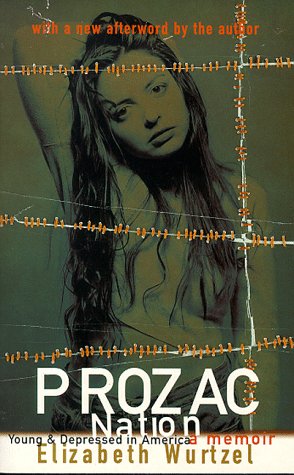
I started reading Prozac Nation by Elizabeth Wurtzel this week, for the second time. Not because I thought it was so great the first time I read it, but because of the opposite. I was 18, in my freshman year of college, and I just didn't get it. I totally lost patience with it, despite plowing through it, and thought it was the whiniest, most self-absorbed piece of tripe I'd ever read. More than once, I wanted to throw the book across the room, and scream, "Get over yourself!!" So when I saw it on a friend's bookshelf this week, I decided to give it another chance, with 12 years and a whole hell of a lot of life experience to bring a new perspective to it.

Well, I still think it's a pretty terrible book. I still think it's whiny and self-absorbed, and the girl can't write particularly well, but it's definitely striking a different chord with me this time. This time, those things don't make me lose patience because I think I can relate to it a lot more. Not least the feeling that when you're depressed, or when you think you're genuinely losing your marbles, you do become pretty self-absorbed, sometimes by necessity. I pick up on the wisdom a little more this time around, and think that she's got some pretty insightful things to say, not just about depression and hysteria, but about the way our society treats mental illness and the people who suffer from it.

One aspect I particularly enjoy is her juxtaposition of the way depression is viewed against the way drug abuse is viewed. Drug abuse is so tangible, it's so - for all intents and purposes - socially condoned and glamorized. Drug use is seen as something people need to be rescued from, that can be fixed. All manner of inappropriate, destructive, thoughtless, and dangerous behavior can be explained away in drug abuse, and as long as the abuser gets help eventually, generally it's all forgotten and chalked up to the drug. It's not the person's fault, it's the drug. As long as no one dies, it's live and let live.

But anyone who's depressed, or has any kind of personality disorder doesn't get the "get out of jail free" card that drug users get. When Wurtzel was a teenager, slashing up her legs with razors and taking overdoses of allergy medications at summer camp, she was told she had no reason to feel so bad, that all she needed was exercise and more socializing, and the problem was mostly ignored. But, she claims, if she'd been going to parties and snorting coke or shooting up heroin, her parents would have had her in the best treatment facility they could afford before the sun was up.

Drug abuse is seen as a disease, whereas personality disorders are seen as flaws. She even hypothesizes that maybe one reason so many people take so many drugs is not necessarily because they just want to be taking drugs, but because it's the only tangible way, short of a serious suicide attempt, to make people understand how awful they feel and that they might just need some serious help. See, if I take drugs, and engage in a slow but serious physical self-destruction, then maybe someone will take my pain seriously.

It's not an argument, I have to say, that I disagree with.

Just because people can hold their lives together, and keep a job, and do their schoolwork and pay their bills, doesn't mean they don't feel like they're crumbling on the inside. It doesn't mean that they're not still constantly filled with a despair so overwhelming that it feels like a physical presence upon, or within, their body, like a slow-growing cancer. Just because a person can get through the day without bursting into tears every time they actually feel like bursting into tears, doesn't mean that life doesn't fill them with an abject terror and sadness that never ceases, no matter what they do, or don't do. It just means they've learned to work around it, fit it into their schedule, fold it into their daily routine. Make it a part of who they are. Some people don't have the luxury of a total breakdown, and I guess in some people's eyes, if you can actually detach yourself from your life enough to say, Well, maybe if I have this breakdown this weekend, like I really want to, it will put my school career in jeopardy or push my poor mother over the edge, so I can't do it. I have to suck it up and keep going, no matter how impossible it may seem or feel, well then, you're not really that bad off.

But god forbid anyone should go out on weekends and do some blow, or need a drink in the morning to face the awful world and the aching dullness of their life.

Those are the people that have serious problems. And sometimes, they're the ones that get the help, often from the intervention of other people. Because it's physical.

Those other people, well, they just need to get some perspective, I guess.

Or so it goes.

Wednesday, December 12, 2007

The Hutto Immigrant Detention Facility


The other day, my friend Deneice showed me a cool documentary she made for her broadcasting class at school, about the Hutto Immigrant Detention Facility, 45 miles north of Austin. For those that don't know, it's basically a holding facility for undocumented immigrants that are picked up until something can be done with them. It's run by the Corrections Corporation of America, a for-profit adult corrections company.

The problem with this place, primarily, is that they hold children there. Entire families are crammed into retrofitted cells (the whole building used to be a medium-security prison), and are locked in. The children are allowed to go play for a little bit each day, but only in a small playground surrounded by razor wire and armed guards. They are disciplined by guards who threaten to separate them from their parents. Pregnant women are also held, with little to no prenatal care.

A cell for an immigrant family.

Is this really what immigration control in the United States has come to? Imprisoning children and threatening them with isolation and violence?

The ACLU, naturally, filed a lawsuit earlier this year and won, requiring the "facility" to make some much-needed improvements. On the link, Barbara Hines, at the bottom right, who has a podcast you can link to, was also interviewed for Deneice's documentary.

My award-winning philosophy paper about Nietzsche*

(Probably not my best work, but considering the vagueness of the assignment (find a text that's confounding, make sense of it, and tell the professor about how you made sense of it in less than 40 pages and make it intelligent), I think I did all right.)

The falseness of an opinion is not for us any objection to it: it is here, perhaps, that our new language sounds most strangely. The question is, how far an opinion is life-furthering, life-preserving, species-preserving, perhaps species-rearing; and we are fundamentally inclined to maintain that the falsest opinions (to which the synthetic judgments a priori belong), are the most indispensable to us; that without a recognition of logical fictions, without a comparison of reality with the purely imagined world of the absolute and immutable, without a constant counterfeiting of the world by means of numbers, man could not live – that the renunciation of false opinions would be a renunciation of life, a negation of life. To recognize untruth as a condition of life: that is certainly to impugn the traditional ideas of value in a dangerous manner, and a philosophy which ventures to do so, has thereby alone placed itself beyond good and evil.
- Friedrich Nietzsche, Beyond Good and Evil


Coming from a place of extreme nominal understanding regarding Nietzsche and his works, the idea of the Will to Power so prominent throughout them is interpreted by myself as the rising up of the oppressed. That is the first thing that comes to mind, though it also represents the power of the powerful. It means, to me, that within every human being lies not only the desire, but a desperate need (indeed, one’s life depends on it) to, at the very least, be in control of their own destiny. At its worst, it is the idea of dominance over growth, moral law enacted simply for the sake of control, not for the sake of personal growth, discovery, or revelation. Or, put another way, it is the enacting of the control of your own outcomes against the dominance of others.

While watching footage of the World Trade Centers’ collapse six years ago, and individuals jumping to their deaths to escape the fiery hell of the burning buildings, I heard a psychologist on the news say that the suicides of those people was in fact a very healthy reaction to an inevitably life-threatening situation. By assessing the crisis rationally, and understanding that they were doomed no matter what, they chose, probably with some combination of panic and level-headed matter-of-factness, their own method of death. Granted, their options were limited, but when faced with the agony of melting, or with the certainty of falling, they chose the certainty. They took control in a hopeless situation where their options were limited, and nonetheless willed themselves to have the smallest modicum of power in a powerless situation. I don’t know why, but while reading the passage by Nietzsche in Beyond Good and Evil, this is what came to my mind.

Robert Cavalier, of the Carnegie Mellon philosophy department, describes the “will to power” as a necessary simplifying of the chaos of nature, and by extension, the chaos of man. He argues that it is precisely this simplification, or “structuring,” that gives individuals power, whether real or perceived. A common psychological theory is that human beings create a narrative for their lives; they take events of their lives and structure them to tell a story that makes sense to them. It is not uncommon, the theory goes, to slightly modify and reinterpret reality so as to make sense in the larger “story” and stream of plot that has been created. Events that confound the storyline, or don’t fit into the larger picture, or are simply unwanted, are often discarded, either consciously or unconsciously, if it makes the story too complex or too untidy. Thus, in the most rudimentary, but also complex way possible, a person has taken control of their life and molded events to fit their own larger picture.

This non-reality is something that I think Nietzsche understood a long time ago, and is largely what he is attacking in Beyond Good and Evil. For something to be “beyond” what it is a part of (such as Nietzsche arguing that evolved morality is beyond both conventional good and evil) that “something” must transcend what it is a part of. To Nietzsche, at least in my interpretation, conventional religion and morality (particularly Christianity) is part of this false story, this created myth, that people tell themselves to feel powerful in a chaotic and scary world. For Nietzsche, I think, this is what “conventional morality” amounts to: a gross simplification in the face of overwhelming ambiguity. For to embrace that ambiguity, or uncertainty, the individual has to come to terms with what they could lose: a solid foundation of assuredness, and possibly even themselves. Some say that faith itself, particularly religious faith, is an acceptance of the uncertainty of the world of the divine, but that may only be true for the most spiritually evolved among us. More often than not, religious “certainty” supplants faith, in order to create a rigid ideology, the mortal enemy of true spiritual evolution and faith. Ideology exists only in the face of insecurity; dogmatic devotion to an impossible ideal replaces genuine seeking. Real answers can only be discovered if one is willing to risk experimentation and questioning without ever discovering a truth, or certainty. This openness, this freedom, is the exact opposite of fundamentalism. Nietzsche disdains these self-perpetuating and stifling lies, but concedes that they are perhaps necessary for society as a whole to continue to function. For without them, he says, “…the renunciation of false opinions would be a renunciation of life, a negation of life.” But why?

Children generally grow up absorbing the beliefs and behaviors of those around them, especially parents or caretakers, rarely questioning the script and role they’ve been delivered since the day of their birth. Traditions are passed down and expectations are expressed, either overtly or indirectly. Until they know better, children see their parents as God, and everything they do, from their language to behavior, is taken note of and digested by children. Some people continue on through life indefinitely drifting, never truly questioning anything, or repressing doubts, for fear of upsetting the status quo, or unprepared for the strength it might take to become autonomous. Others, however, through choice or circumstance, make a resolute decision to embrace uncertainty and the falling away from, or “dying,” if you will, of their old or comfortable life. Some don’t have a choice: they’re given their script as they’re about to walk out onto the proverbial stage, and their script is written in an indecipherable language. Try as they might to learn the new language, quickly and without error, they simply can’t. So they’re pushed on stage, and they either flounder or they improvise.

When a person throws away their script in order to write a new one, they make a deliberate choice. They’ve taken what they see as false opinion and renounced that life, negated its worth, at least to them, and effectively killed it. This is the death that Nietzsche refers to. In order to evolve, old ways must die. Usually the script is never complete unless one prematurely pronounces it so; true “being” is an endless becoming, a never-ending journey for truth and self. The “they-self” concept of how one has created an identity in relation to what others expect of them is gone, replaced by a resolute choice to become, or create, something new.

Growing up, I always felt different, from day one. It was difficult for me to relate to other kids, especially boys, and I had no interest in sports. Friends came and went, and the majority of my relationships with other kids were short-lived. It wasn’t until puberty, really, and the budding of sexual desires, that I began to fully understand what it was that set me apart. Despite my growing attraction to other boys that was both confusing and exciting, and my growing disinterest in girls as anything other than companions, I still held on to my prescribed script for dear life. Letting go of my future storyline was too scary, too unknown. I fell into a vicious pattern of self-deception: still told myself I would get married someday, I would have children, and a family, and I would live the life that I was expected to live. I mean, what else was there? Despite being an avid reader with a huge imagination, the only world I truly knew was rural Arkansas. I knew there was more out there, but I didn’t understand it. Falling in love with my best friend at 16, and having him return those feelings, was the final nail in the coffin of my old life. It took another good 5 years to become comfortable with the idea of letting the old life truly die, and to have the courage to construct a new one in the way I saw most appropriate, but with that final decision, the new world was created, and my own moral and intellectual limits of my effective freedom were killed.

In many ways, I continue to define myself by what I am not, by my opposition to what I find most distasteful: complacency, blind religious faith, a denial of the true self. I seek to see reality in everything, and to view any adherence to mythology as a weak-willed embrace of a false certainty in the face of a vague and scary uncertainty. But the uncertainty is the reality, multiplicity the true liberator of the human psyche. Without a recognition of “logical fictions,” Nietzsche claims, man would die in his own meaninglessness. To have to discover your own path, and create your own destiny, as the existentialist believes we must all do in the absence of God, would provoke too much anguish and self-doubt in all of mankind, and surely lead to the death of life. But what I believe Nietzsche is arguing is that, if mankind as a whole could abandon these false notions, this “constant counterfeiting,” then as a species, we could evolve beyond our conventional and tired notions of morality, of even viewing morality in terms of good and evil. A transcendent morality might take its place, one in which all beings were equal and autonomy could be prized and strived for, instead of feared, denigrated, and eventually murdered.

*By "award-winning," I mean I got an A.

Saturday, December 08, 2007

Another Austin blog


This one's about condos: Austin Towers. It's self-described as a guide to condo shopping in Austin, but it also provides lots of commentary, insights, and general information on the changing face of central Austin. And since I'm totally obsessed with all this shit, I really like it. I actually spent hours on it the other night just clicking around on all the links.

One recent post I really enjoyed was about Austin's density problem. Density is measured by the number of people living per square mile, and Austin came in 20th in the top 25 with only 2,610 people per square mile (as opposed to New York's nearly 27,000 people per square mile, followed by San Francisco, Chicago, Boston, and Philadelphia in the top 5). The count was taken in 2000, though, so I'm sure it's improved since then, but no one can argue that Austin isn't suburban. If you need any further evidence, look to the fact that many proprietors of failed businesses in the 2nd Street District blame their failure on a lack of good parking.

Anyway, that's what all this crazy condo business is looking to improve, so let's hope it does.

Urban Roots

Urban Roots is a program developed by Youth Launch, an Austin-based nonprofit, to educate Austin's inner-city youth about growing food and healthy eating. I spoke to a representative at the farmer's market this morning, and he said they plan to break ground by April of 2008, and get kids planting food and tending a garden. It's designed to teach the kids about sustainable agriculture, and they will donate I think he said 25% of the food to soup kitchens and keep or sell the rest.

This week, December 8-13th, they are teaming up with Edible Austin and a whole host of local restaurants to help raise money in what they are calling "Eat Local Week." The restaurants on the list have all agreed to have one meal on the menu that's made entirely from locally-grown food, and that $1 from every meal sold throughout the week will be donated to the Urban Roots program.

So Austinites, if you go out to eat this week, think about visiting one of the sponsoring restaurants and buying the local meal. The list of participating restaurants and markets is here.

Friday, December 07, 2007

Boy Scout Ambivalence


By now I'm sure everyone's heard that the Boy Scouts got kicked out of their headquarters in Philadelphia for refusing to change their anti-gay bigotry. I understand the city's position and I don't sympathize with the Boy Scouts at all, but something about this kind of rubs me the wrong way.

Municipal officials said the clash stemmed from a duty to defend civil rights and an obligation to abide by a local law that bars taxpayer support for any group that discriminates. Boy Scout officials said it was about preserving their culture, protecting the right of private organizations to remain exclusive and defending traditions like requiring members to swear an oath of duty to God and prohibiting membership by anyone who is openly homosexual.

This week the Boy Scouts made their last stand and lost.

“At the end of the day, you can not be in a city-owned facility being subsidized by the taxpayers and not have language in your lease that talks about nondiscrimination,” said City Councilman Darrell L. Clarke, who represents the district where the building is located. “Negotiations are over.”


I don't know much about the Boy Scouts; as a kid I was never remotely interested in joining (I was in the Webloes for one year, but my best girlfriend down the street couldn't be in them, so I quit), but I know that for a lot of kids, it's a lifesaver. I would prefer that their lifesaver not be such an intolerant lot, but nevertheless, sometimes I think there are things that trump being progressive. Of course, if the city is going to take a hardline approach to this stuff, it can't go around making exceptions, especially for religious groups, which, in any other circumstance I'd say kick the free-loading bastards out.

Philadelphia has an astronomical crime rate and ridiculous poverty levels, and at least according to a Boy Scout spokesman for the Philadelphia chapter, having to pay the full rent on the building (which the city estimates at $200,000 annually) would require that they cut funding for summer camps for low-income, inner-city kids. Maybe that's not true, or maybe it's irrelevant. It seems too bad, though, that it has to be either/or. The whole situation kind of depresses me.

But what I guess is really too bad is that the Boy Scouts have to be such bigots. That doesn't serve anybody.

Tuesday, December 04, 2007

Coulda been....

This past week I've been working on my final philosophy paper which is about a section of Beyond Good & Evil by Nietzsche. My paper is sort of a dissection of the concept of will to power and how "conventional morality" is for weak people (thus, the title of the book). It's not my best paper, that's certain, but the assignment was rather vague, purposefully. But it's not a terrible paper, either, and the fact that I could probably write another 50 pages doesn't help (the length limit was "under 40 pages; however long it takes you to write something intelligent. And I'll be the judge of what's intelligent."). That's the problem with philosophy and why philosophers are all just a little bit crazy: the constant asking of questions while never really getting any real answers. An entire life of "what-if's" and "how about's" seems like it could drive a person mad. Psychology's not much better but at least you can apply practical uses from psychology and you can do testing. Some answers are better than no answers. Although I'm sure any philosopher worth his salt would argue with me until next week that no answers are ever found in philosophy. And also that that's not the point.

I feel like my life is a constant series of "what-if's" as well, only I don't call it philosophy, I call it being obsessive. Does everyone do this? I don't know: readers, do you all constantly do this as well?

Like, I think things like:

- What if I had ended up going to Sarah Lawrence instead of moving to Dallas, which is what I really wanted to do? I never could have gotten in to Sarah Lawrence, and even if I had, I never could have afforded it, but what if I had? What would I be doing now?

- What if I had stayed in Arkansas instead of going to college in Dallas?

- What if I had moved to Los Angeles after I got out of school instead of moving to Austin?

- What if, about 9 months after moving to Austin, I had packed up again and moved to New York, like I very nearly did? Collier was moving back and needed a roommate and she asked me if Travis (my boyfriend at the time) and I would be interested in taking the extra room? I was all for it, but naturally, Travis wanted nothing to do with it. I almost broke up with him and left anyway, but he'd just moved to Austin from Arkansas to be with me about 4 months prior, so of course I couldn't do that. Only a total douchebag would do that.

- What if I hadn't met the friends that I met? What if I met them now, instead of years ago? Would we still have hit it off, or is meeting people always a result of a very specific set of circumstances that brings you together at a specific time?

It's all sort of terrifying and endlessly exhausting to think about, but I always do.

Sorry the posts lately have not only been slow, but also incredibly lame. School's over after this week, so hopefully I'll get back on track. These last 3 weeks have almost killed me.