Do you think the food you buy says a lot about you? It seems to me that what you eat, and what your politics are probably both say a lot about you, though I'm not sure what it says, exactly. It's weird, though, how many people seem to think their grocery lists reveal too much.
Recently at work, at the end of the night, one of my managers was buying a handfull of stuff. I was off running some in-store errand, and he saw me walking back and said he was going to follow me back to my register, and have me check him out. His reasoning was that he didn't like people asking him questions about what he was buying, and he trusted me not to ask questions.
Huh?
Well, I disappointed him, because he was buying a very unique and odd plant and I made the mistake of asking him about it. Turns out he was buying it as an office-warming gift for his boyfriend's new office, but he jokingly expressed his disapproval at my asking.
Also, in the CD club that I'm in, someone mailed out their monthly CD to everyone with everyone's track listing written on his old grocery lists. Whether it was to save paper or just be unique, I don't know, but on the shared blog we have, someone pointed it out and said something along the lines of, "I feel like I know you so much better now, after reading your delightful shopping list." My first instinctive reaction was that I would never do that, because I don't want everyone to know what I buy at the grocery store, either.
But why not? Is it that personal? Customers often ask me if I judge people by what they buy. I'd never really thought about it, but I guess, yeah, occasionally, but not very often. Only if it's extreme. Like, the people who are always in gym clothes and buy nothing but boxes and boxes and boxes of frozen meals and 400 protein bars and 80 cases of Vitamin Water, and you know that's all they eat. I guess I sort of judge those people. Or just feel empathy for their future doctor bills.
Or the women who attend the Weight Watchers meetings on Tuesday mornings, then go shopping and spend $8 on a box of Weight Watchers brand protein bars, but then also buy 4 boxes of cookies and a bag of bagels. Or 3 pints of ice cream.
But I actually judge people far more harshly by how neurotic they are about how their groceries are bagged, or how many extraneous and totally unnecessary bags they use.
I mean, I'm really neurotic about how my groceries are bagged too, so I always bag them myself. Problem solved.
Does anyone else think their grocery lists are really personal? Do you ever feel embarrassed at the grocery store when you buy certain things? Cuz I do. I'm always embarrassed when I buy soda or potato chips. Or sliced lunch meat. I have no idea why, but for some reason I find buying sliced lunch meat kind of depressing.
I know, I'm a weirdo.
Showing posts with label Food. Show all posts
Showing posts with label Food. Show all posts
Wednesday, June 04, 2008


Monday, May 12, 2008
Runner's High
Despite liking the store overall, I have some serious issues with my employer. For what they claim to be, they certainly have no standards for what they will or won't sell, including processed products loaded with high fructose corn syrup, MSG, chemical preservatives, and hydrogenated fats. You also can't get locally grown, grass-fed beef there. Or grass-fed beef at all.
In a meeting the other day though, our GM made several announcements concerning some decisions they'd made. For one, he said, and this was a big one, they are going to seriously cut back on the amount of bottled water they sell. He said (and I'm paphrasing) that it just didn't make sense to import water from Brazil, or New Zealand, or Fiji, when it consumed so much fuel and the manufacturing of bottled water was in itself so wasteful (in case you didn't know, it takes three times the amount of water that's in a bottle to create each bottle, not to mention the petroleum used to make the bottles and then the subsequent waste). The "house brand" water they sell there, incidentally, is bottled in New Zealand, so it makes me wonder if they're going to discontinue the house brand or just start bottling it somewhere else.
The other major announcement he made was that the company is going to start specializing in a lot more seasonal, locally-grown produce instead of importing so much of it from Mexico and South America.
Which made my little heart bounce with joy. Of course, the cynical side of me knows that they're only doing these things because fuel is so expensive (the GM even admitted that) and not out of any kind of obligation to local farmers, but I'll take it where I can get it.
And this, my friends, is why I think the rising gas prices are a good thing. If even huge $3 billion corporations are feeling that much pinch from gas that's not even $4 a gallon yet (and really, that's small potatoes compared to what most of Europe pays for gas), imagine what will happen when it reaches $5 or $6. At least a few people are starting to think ahead.
I think it's really idiotic to hear Clinton and McCain talk about a summer gas tax holiday out of one side of their mouths, then talk about the need to invest in other fuel sources out of the other. Not to mention that once the "holiday" is over, prices are going to go up even higher than they are now to compensate for the lost revenue over the summer. The only thing that's going to make people take a gas shortage seriously is.... a gas shortage! If that's what it takes to start making out economies more locally-based, I'm all for it. I'm fortunate to live in an urban area with a lot of stuff at my disposal (including public transportation, such as it is...) and I know that. Not everyone's so lucky. And that sucks. But I've never quite understood why we put so much emphasis on people's comfort and jobs or whatever, over environmental health. It just doesn't make any sense.
On another note, I started running again this morning, and I really got that light-headed runner's high. It was pretty great. Last time I ran regularly I was still smoking heavily and was most likely not getting the oxygen I needed. Well, I'm sure I was this time. And I only plan on running once, maybe twice a week, not three times a week like last time when I lost so much weight so quickly and got really freaked out. I also wasn't eating enough back then.
My legs are a little wobbly right now but it feels really good.
In a meeting the other day though, our GM made several announcements concerning some decisions they'd made. For one, he said, and this was a big one, they are going to seriously cut back on the amount of bottled water they sell. He said (and I'm paphrasing) that it just didn't make sense to import water from Brazil, or New Zealand, or Fiji, when it consumed so much fuel and the manufacturing of bottled water was in itself so wasteful (in case you didn't know, it takes three times the amount of water that's in a bottle to create each bottle, not to mention the petroleum used to make the bottles and then the subsequent waste). The "house brand" water they sell there, incidentally, is bottled in New Zealand, so it makes me wonder if they're going to discontinue the house brand or just start bottling it somewhere else.
The other major announcement he made was that the company is going to start specializing in a lot more seasonal, locally-grown produce instead of importing so much of it from Mexico and South America.
Which made my little heart bounce with joy. Of course, the cynical side of me knows that they're only doing these things because fuel is so expensive (the GM even admitted that) and not out of any kind of obligation to local farmers, but I'll take it where I can get it.
And this, my friends, is why I think the rising gas prices are a good thing. If even huge $3 billion corporations are feeling that much pinch from gas that's not even $4 a gallon yet (and really, that's small potatoes compared to what most of Europe pays for gas), imagine what will happen when it reaches $5 or $6. At least a few people are starting to think ahead.
I think it's really idiotic to hear Clinton and McCain talk about a summer gas tax holiday out of one side of their mouths, then talk about the need to invest in other fuel sources out of the other. Not to mention that once the "holiday" is over, prices are going to go up even higher than they are now to compensate for the lost revenue over the summer. The only thing that's going to make people take a gas shortage seriously is.... a gas shortage! If that's what it takes to start making out economies more locally-based, I'm all for it. I'm fortunate to live in an urban area with a lot of stuff at my disposal (including public transportation, such as it is...) and I know that. Not everyone's so lucky. And that sucks. But I've never quite understood why we put so much emphasis on people's comfort and jobs or whatever, over environmental health. It just doesn't make any sense.
On another note, I started running again this morning, and I really got that light-headed runner's high. It was pretty great. Last time I ran regularly I was still smoking heavily and was most likely not getting the oxygen I needed. Well, I'm sure I was this time. And I only plan on running once, maybe twice a week, not three times a week like last time when I lost so much weight so quickly and got really freaked out. I also wasn't eating enough back then.
My legs are a little wobbly right now but it feels really good.
Friday, May 09, 2008
Saturday, December 08, 2007
Urban Roots
Urban Roots is a program developed by Youth Launch, an Austin-based nonprofit, to educate Austin's inner-city youth about growing food and healthy eating. I spoke to a representative at the farmer's market this morning, and he said they plan to break ground by April of 2008, and get kids planting food and tending a garden. It's designed to teach the kids about sustainable agriculture, and they will donate I think he said 25% of the food to soup kitchens and keep or sell the rest.
This week, December 8-13th, they are teaming up with Edible Austin and a whole host of local restaurants to help raise money in what they are calling "Eat Local Week." The restaurants on the list have all agreed to have one meal on the menu that's made entirely from locally-grown food, and that $1 from every meal sold throughout the week will be donated to the Urban Roots program.
So Austinites, if you go out to eat this week, think about visiting one of the sponsoring restaurants and buying the local meal. The list of participating restaurants and markets is here.

This week, December 8-13th, they are teaming up with Edible Austin and a whole host of local restaurants to help raise money in what they are calling "Eat Local Week." The restaurants on the list have all agreed to have one meal on the menu that's made entirely from locally-grown food, and that $1 from every meal sold throughout the week will be donated to the Urban Roots program.
So Austinites, if you go out to eat this week, think about visiting one of the sponsoring restaurants and buying the local meal. The list of participating restaurants and markets is here.

Tuesday, November 06, 2007
Hillary's environmental plan
David, over at Gristmill, an environmental blog I recently discovered, has a rundown of H. Clinton's recently unleashed environmental agenda. Some of it I don't really understand (can anyone adequately explain environmental "credits" to me, and what all of that means?), and some of it I was just as agog as David and several commenters seem to be.
Like, the continued use of coal, though the whole CCS thing I don't quite get, either. Also, her use of the phrase "foreign oil." I, like several other people reading, don't understand why people keep saying this. Obviously it's a nod to not being so enmeshed in so many Middle Eastern countries for our oil dependence, but does that mean we have to destroy our own in the process? What about moving away from oil entirely? I honestly don't believe deep in my soul that we could send people to the moon 40 years ago, but we still haven't come up with an adequate substitute for fuel. Partly it's our lifestyle, and Hillary's $1 billion subsidy for the formation of more public transportation doesn't bode well for her commitment to weaning America off of its deadly addiction to cars and airplanes. It's cultural, and I'm not sure there is a solution at all, until it all just runs out, and everybody is then totally fucked. Which will then make everyone at the complete mercy of the "market," and only the very, very privileged will be able to travel within, and especially out of, their city.
Urban density is nice, but without adequate and reliable public transportation what does it accomplish? Nothing. It simply turns downtown into an exclusive neighborhood that people still drive out of to go to work in the suburbs. Instead of the other way around. And why is no one building electric bullet trains in the United States that have been prominent in Japan for years? And why aren't more politicians (and corporations) investing in subsidizing local farmers so that more people are able to buy meat, dairy and produce locally instead of having it shipped in? Because they throw all the farm subsidies at corn, which is why every god damn thing in the world has high fructose corn syrup in it. It's been proven that cars and the beef industry are the two biggest polluters that exist. Subsidizing energy efficency is great, but what about the lifestyle itself? This isn't something you ever really see politicans address, and maybe it's for more than lobbyist reasons. Maybe because it's unfixable. Maybe because people's use of public transportation and consumption of food only produced within 100 miles of where they live are issues that can only be addressed by the market. You can't force people to ride the bus (such as it is, with homeless people fighting next to you, not once, but twice in one day) or buy locally produced, and family-farm-grown, milk and meat.
I know, baby steps. And this is the United States. People don't change until it affects their wallets. And at this point maybe we're so far gone that it will take a major catastrophe (or multiple major catastrophes on the scale of Katrina) before people, as a whole, respond.
Thoughts, anyone? Am I a raving lunatic or is any of this making sense?
I'm drunk.
Like, the continued use of coal, though the whole CCS thing I don't quite get, either. Also, her use of the phrase "foreign oil." I, like several other people reading, don't understand why people keep saying this. Obviously it's a nod to not being so enmeshed in so many Middle Eastern countries for our oil dependence, but does that mean we have to destroy our own in the process? What about moving away from oil entirely? I honestly don't believe deep in my soul that we could send people to the moon 40 years ago, but we still haven't come up with an adequate substitute for fuel. Partly it's our lifestyle, and Hillary's $1 billion subsidy for the formation of more public transportation doesn't bode well for her commitment to weaning America off of its deadly addiction to cars and airplanes. It's cultural, and I'm not sure there is a solution at all, until it all just runs out, and everybody is then totally fucked. Which will then make everyone at the complete mercy of the "market," and only the very, very privileged will be able to travel within, and especially out of, their city.
Urban density is nice, but without adequate and reliable public transportation what does it accomplish? Nothing. It simply turns downtown into an exclusive neighborhood that people still drive out of to go to work in the suburbs. Instead of the other way around. And why is no one building electric bullet trains in the United States that have been prominent in Japan for years? And why aren't more politicians (and corporations) investing in subsidizing local farmers so that more people are able to buy meat, dairy and produce locally instead of having it shipped in? Because they throw all the farm subsidies at corn, which is why every god damn thing in the world has high fructose corn syrup in it. It's been proven that cars and the beef industry are the two biggest polluters that exist. Subsidizing energy efficency is great, but what about the lifestyle itself? This isn't something you ever really see politicans address, and maybe it's for more than lobbyist reasons. Maybe because it's unfixable. Maybe because people's use of public transportation and consumption of food only produced within 100 miles of where they live are issues that can only be addressed by the market. You can't force people to ride the bus (such as it is, with homeless people fighting next to you, not once, but twice in one day) or buy locally produced, and family-farm-grown, milk and meat.
I know, baby steps. And this is the United States. People don't change until it affects their wallets. And at this point maybe we're so far gone that it will take a major catastrophe (or multiple major catastrophes on the scale of Katrina) before people, as a whole, respond.
Thoughts, anyone? Am I a raving lunatic or is any of this making sense?
I'm drunk.
Thursday, November 01, 2007
Horizon lawsuit continued
Apparently, the lawsuit against Horizon's parent company, Dean foods, has been dropped by the USDA. Despite Cornucopia's claims to Dean Foods' "14 willful violations" of organic standards, the USDA continued to let them operate, and has dropped investigations in response to Coruncopia's 2006 filing.
Some blame powerful friends in Washington, which wouldn't surprise me at all, but I also thought this paragraph was very telling:
“It must pay to have powerful friends in Washington, DC!,” said Dave Minar, a long-time organic dairyman milking 150 cows near New Prague, Minnesota. “The USDA has ignored well-documented concerns about the propriety of these factory-farms for years, allowing large corporate agribusiness to take over a majority of the organic dairy business. This places ethical families like mine at a distinct competitive disadvantage.”
It makes one wonder (well, at least it makes me wonder) if perhaps some of this wasn't overblown a little due to an anti-corporation agenda. Which, if it is the case, isn't the worst kind of agenda to have, to be sure. Nevertheless, if Cornucopia is fudging the truth to make the ends justify the means, I have a problem with that.
On the other hand, I have absolutely no doubt that the Aurora farms were in violation of organic standards, and if they've lost significant market share over this, well, I'm not gonna sit around crying for them.
Either way, the whole deal is pretty shady if you ask me, and I'll stick to my Central Market and Organic Valley products. I never really buy Horizon stuff anyway, but I'll definitely be sure not to now. And I did find out that the farm that bottles Central Market's Organics brand milk is a family farm east of San Antonio.
Which made me happy. But I do plan to put in a call to Central Market's procurement office tomorrow to ask if they're aware of all of this Horizon business. If you're interested in calling them yourself, the number is 512.421.1085.
Some blame powerful friends in Washington, which wouldn't surprise me at all, but I also thought this paragraph was very telling:
“It must pay to have powerful friends in Washington, DC!,” said Dave Minar, a long-time organic dairyman milking 150 cows near New Prague, Minnesota. “The USDA has ignored well-documented concerns about the propriety of these factory-farms for years, allowing large corporate agribusiness to take over a majority of the organic dairy business. This places ethical families like mine at a distinct competitive disadvantage.”
It makes one wonder (well, at least it makes me wonder) if perhaps some of this wasn't overblown a little due to an anti-corporation agenda. Which, if it is the case, isn't the worst kind of agenda to have, to be sure. Nevertheless, if Cornucopia is fudging the truth to make the ends justify the means, I have a problem with that.
On the other hand, I have absolutely no doubt that the Aurora farms were in violation of organic standards, and if they've lost significant market share over this, well, I'm not gonna sit around crying for them.
Either way, the whole deal is pretty shady if you ask me, and I'll stick to my Central Market and Organic Valley products. I never really buy Horizon stuff anyway, but I'll definitely be sure not to now. And I did find out that the farm that bottles Central Market's Organics brand milk is a family farm east of San Antonio.
Which made me happy. But I do plan to put in a call to Central Market's procurement office tomorrow to ask if they're aware of all of this Horizon business. If you're interested in calling them yourself, the number is 512.421.1085.
Friday, October 26, 2007
Horizon Milk being sued

It's sort of pathetic that I work where I do and it took a customer to bring this to my attention. We get a lot of ranting weirdos in there (my favorite so far is the customer that tried to convince me last fall that the spinach recall was a conspiracy by the government to get people to stop eating organic produce), so I kind of blew the lady off when she wanted to speak to someone to find out "why you're still selling Horizon products!"
Since I was at the information desk, I had internet access, so I started digging around, investigating the ladie's accusations. Turns out, it's true. Aurora Dairy Corporation, which provides Horizon with its milk, is being hit with allegations of "fraud, negligence, and unjust enrichment concerning the sale of organic milk by the company."
Independent investigators at the USDA concluded earlier this year that Aurora--with five dairy facilities in Colorado and Texas, each milking thousands of cows--had 14 "willful" organic violations. One of the most egregious findings was that from December 5, 2003, to April 16, 2007, the Aurora "labeled and represented milk as organically produced, when such milk was not produced and handled in accordance with the National Organic Program regulations."
They have also been accused of exploiting and jeopardizing the livelihood of small family farms by taking advantage of the premium prices consumers are willing to pay for organic prices, while not actually offering organic products.
I've always heard that if you don't buy anything else organic, you should buy your milk organic, because the dairy industry is one of the dirtiest and most insidious. You can get ratings on all kinds of companies at the Cornucopia Institute, which also has a link to another article about Horizon, and gives them the lowest rating possible. I really enjoy Organic Valley, because they're a co-op, and everything is grown locally (how fucking stupid is it to grow organic milk in Colorado or Texas and ship it to Maine or Washington?? For instance.) However, their products also always seem to go bad a good 2 or 3 days before the expiration date, and their stuff ain't cheap. Which annoys me. My favorite milk is probably the Central Market organic brand. I actually never buy Horizon to begin with. I used to a long time ago, but stopped because I just didn't think it tasted that good. I think the Central Market tastes the best of all the milk I've had, including the Whole Foods brand. However, I have no idea where it comes from, and seeing as how Aurora has a farm in Texas, it's possible it comes from them. I need to find out, though I desperately hope not. Maybe it will come from the Organic Valley farmers, and then I'll be in a win-win!
Tuesday, September 18, 2007
One of my very least favorite words
Foodie.
It's so precious. It's too cute. It sounds like something a 5-year-old would say.
Foodie.
It sounds like snotty, bratty, cootie, puny, whiny. Why do so many negative-sounding words end with a long "e" sound? (But I guess so does happy, funny, pretty, etc.)
Mostly, though, I hate what it means. I hate it when I'm at a party full of artist types, and one of them starts talking about lamb chops, and another one says, "Oh, you must be a foodie!" And the one talking about lamb chops replies, "Oh, I'm a total foodie. I love food and cooking."
Gag.
There's nothing wrong with food and cooking, but don't call yourself a fucking foodie.
I don't know which price-gouging, elitist supermarket coined the term first, or if it's a regular word that's been around for a long time, but I despise what it implies.
I hate that it implies a lifestyle of picking only the best organic produce flown in from the indiginous regions of wherever, and only the most choice and select meats, wines, cheeses, and chocolates.
I hate that it implies only wealthy people, or people of a certain privilege, should have the right to eat healthy, uncontaminated, and "sustainably grown" food, even though that term actually means very little when you're dealing with corporate supermarkets scouring the world for food they can use to sell a lifestyle and an image.
I hate that it's a term only privileged people use. I can assure you that poor people who grow their own food, or who actually care about where the food they purchase comes from, or struggle to buy food for their children that isn't filled with preservatives, sugar, chemicals, and processed beyond anything recognizably natural, don't call themselves "foodies." They call themselves people struggling to feed themselves and their families something natural and nourishing.
There's nothing inherently wrong with a consumer culture that's based on conservation and sustainability, but let's not kid ourselves. It's still a consumer culture, and it's still all about bottom-line profit above all else (Whole Foods and Central Market both made gross profits in the billions last year), and it all just kind of makes me want to throw up. I'm just as guilty as anyone else. I love those stores. I love the products, I love the ambience. But I'm also privileged and don't have a family to support. Anymore, when I pay $1.79 for a box of organic macaroni and cheese, or $2.29 a pound for a red bell pepper, when they're $1.17 each at Randalls, it just makes me wonder what the fuck I'm doing, and really supporting. And why.
More and more lately, though, I've become interested in growing my own vegetables and volunteering at some local community garden. I found this great web site tonight, all about Austin's local community gardens, and how to create a truly sustainable food source. It's by putting it in your backyard. I think I want to start volunteering there. In all my free time....
I probably don't know what the fuck I'm talking about with any of this, but I sure do hate the word "foodie."
It's so precious. It's too cute. It sounds like something a 5-year-old would say.
Foodie.
It sounds like snotty, bratty, cootie, puny, whiny. Why do so many negative-sounding words end with a long "e" sound? (But I guess so does happy, funny, pretty, etc.)
Mostly, though, I hate what it means. I hate it when I'm at a party full of artist types, and one of them starts talking about lamb chops, and another one says, "Oh, you must be a foodie!" And the one talking about lamb chops replies, "Oh, I'm a total foodie. I love food and cooking."
Gag.
There's nothing wrong with food and cooking, but don't call yourself a fucking foodie.
I don't know which price-gouging, elitist supermarket coined the term first, or if it's a regular word that's been around for a long time, but I despise what it implies.
I hate that it implies a lifestyle of picking only the best organic produce flown in from the indiginous regions of wherever, and only the most choice and select meats, wines, cheeses, and chocolates.
I hate that it implies only wealthy people, or people of a certain privilege, should have the right to eat healthy, uncontaminated, and "sustainably grown" food, even though that term actually means very little when you're dealing with corporate supermarkets scouring the world for food they can use to sell a lifestyle and an image.
I hate that it's a term only privileged people use. I can assure you that poor people who grow their own food, or who actually care about where the food they purchase comes from, or struggle to buy food for their children that isn't filled with preservatives, sugar, chemicals, and processed beyond anything recognizably natural, don't call themselves "foodies." They call themselves people struggling to feed themselves and their families something natural and nourishing.
There's nothing inherently wrong with a consumer culture that's based on conservation and sustainability, but let's not kid ourselves. It's still a consumer culture, and it's still all about bottom-line profit above all else (Whole Foods and Central Market both made gross profits in the billions last year), and it all just kind of makes me want to throw up. I'm just as guilty as anyone else. I love those stores. I love the products, I love the ambience. But I'm also privileged and don't have a family to support. Anymore, when I pay $1.79 for a box of organic macaroni and cheese, or $2.29 a pound for a red bell pepper, when they're $1.17 each at Randalls, it just makes me wonder what the fuck I'm doing, and really supporting. And why.
More and more lately, though, I've become interested in growing my own vegetables and volunteering at some local community garden. I found this great web site tonight, all about Austin's local community gardens, and how to create a truly sustainable food source. It's by putting it in your backyard. I think I want to start volunteering there. In all my free time....
I probably don't know what the fuck I'm talking about with any of this, but I sure do hate the word "foodie."
Friday, September 07, 2007
Post-American Landscape

In the July 2007 issue of Harpers, Rebecca Solnit (whom I once quoted here) has a wonderful article about the rise, then fall, and then perhaps second rising of one of America's most despised and feared cities: Detroit. At some point you maybe begin wondering what all the ink is about: she traces its beginnings from the soggy, post-ice age wetlands settled by the French, who utilized local natives to help set up a trading post that became a "strategic site in the scramble between the British and the French to dominate the North American interior." She follows its rise in the early 20th century due to the automobile industry: in 1900, about 250,000 people lived there, but by mid-century, it was home to almost 2 million, but has now fallen back below 900,000 again, with an average 10,000 people leaving the city every year. It was a victim of its own success, however, as the industry it created ate its own urban core (along with all of America's), giving rise to sprawl and suburbia, effectively killing off the industry itself (particularly in a town where one-fifth of the population doesn't even own a car). Of course, Detroit wasn't the only one-industry city destroyed by decentralization and creeping globalization. Cleveland, Toledo, Buffalo, St. Louis, Pittsburgh, New York City, and San Francisco were also all basically dried up by the loss of blue-collar jobs and factories.
 All of those cities, though, in one way or another, managed to recover, some of them spectacularly (San Fran and NYC, particularly), but not Detroit. As Solnit says, "The new American cities trade in information, entertainment, tourism, software, finance. They are abstract...the forces that produced Detroit - the combination of bitter racism and single-industry failure - are anomalous, but the general recipe of deindustrialization, depopulation, and resource depletion will likely touch almost all regions of the global north in the next century or two." Our way of life is over; the sprawling suburbs and automobile culture are no longer sustainable, but Detroit, by sheer necessity, may be the first of the cities "forced to become altogether something else."
What is that something else? Agriculture.
So many homes have fallen down and been destroyed, and there is now so much blank and unused urban space (even some of the downtown skyscrapers apparently have trees and plants growing up through them) that people are taking it over and creating urban gardens. Activist and long-time Detroit resident Jimmy Boggs and his wife Grace began to realize that instead of trying to regain a severed tie to capitalism, Detroit should embrace an economy entirely apart from "transnational webs of corporations and petroleum." In other words, turn Detroit's liabilities (urban ruin and unused space) into assets. In their words, that included "small enterprises which produce food, goods, and services for the local market, that is, for our communities and our cities."
One woman, who had been the first black woman on her block and is now nearly the last person on that block, period, bought three lots that surrounded her home and now raises almost all of her own food on them. The three-acre Earth Works Garden, launched by Capuchin monks, grows organic produce for a local soup kitchen. The local 4-H organizations have begun planting and tending small gardens on the ravaged east side. And on the west side, the Catherine Ferguson Academy for Young Women recently opened. It's a school for teenage mothers "that opens on to a working farm, complete with apple orchard, horses, ducks, long rows of cauliflower and broccoli, and a red barn the girls built themselves." The Greening of Detroit sponsors thousands of community gardens. "Urban farming," says Ashley Atkinson, project manager, "dollar for dollar, is the most effective change agent you can ever have in a community."
It's an inspiring message, and one that more cities (I'm looking at you, New Orleans) should take to heart.
Solnit closes with this insightful passage:
"Everyone talks about green cities now, but the concrete results in affluent cities mostly involve curbside composting and tacking solar panels onto rooftops while residents continue to drive, to shop, to eat organic pears flown in from Argentina, to be part of the big machine of consumption and climate change. The free-range chickens and Priuses are great, but they alone aren't adequate tools for creating a truly different society and ecology. The future, at least the sustainable one, the one in which we all survive, isn't going to be invented by people who are happily surrendering selective bits and pieces of environmentally unsound privilege. It's going to be made by those who had all that taken away from them or never had it in the first place."
 A young gardener at the Earth Works Garden.
Wednesday, May 02, 2007
Vegetables

It's weird when you start to truly realize the discrepancy between the person you are, and the person you sort of wish you were. I don't mean on any deep level, just on a more superficial, things you'd "like to do" level.
I was reminded of that yesterday on Salon, when I saw this, a story about a woman who grew a garden and nothing but locally grown food for a year, presumably for environmental reasons, but also just to pay, and draw more attention, to America's eating habits.
I love the story. I always fantasize about one day having a big garden that I tend to, and where I grow fresh veggies and herbs, and cook sumptuous stews and meals from what I've grown, and it's delicious and I feel really good about it.
I can't even keep houseplants alive. I'll never be a gardener. That kind of makes me sad. And furthermore, I never even shop at the Farmer's Market on the weekends, which I've pretty much wanted to do ever since I moved to Austin. I love the idea of that lifestyle. It seems cozy, and reeks of a settled domesticity.
Eh, maybe someday I'll be that person when I'm older and need more hobbies.
Monday, February 19, 2007
Schmerks
One of the few (only) perks of my job is that we get to attend one cooking class every month for free. I've always meant to take advantage of it, but never did until tonight. Yesterday at work a certain very cute boy told me he was taking one tonight and asked if I cared to join him, so naturally I immediately went and signed up.
It turns out it was a class called "Prego Entertains," and was led by John Watt, the owner and head chef of Prego and Trevisio, both upscale Italian restaurants in Houston.
I don't know if I actually learned a whole lot of very useful information (unless I'm hosting a dinner party for 30), but damn, I sure ate a shitload of delicious food, and got 2 glasses of wine.
It started out with a Tri Colore Salad, made with an amazingly savory Lemon Vinaigrette dressing (actually, very similar to the dressing I always make with my salads at home, but with a few more little ingredients).
Then we had rigatoni with pancetta, roasted root vegetables and scallions. It was incredibly rich (as is most Italian food), and filling. This would be incredibly simple to make, actually, and I may attempt it myself soon. He made a creamy, but not too thick, sauce with heavy cream and white wine that was extraordinary that I would probably never attempt at home, but at least I'm pretty sure I could.
Next we had Salmon with caramelized onions and bianco. Again, very rich and heavy, but absolutely delicious. He also seared then baked the salmon, and I usually pan cook mine, so I'm going to start baking, I think. It doesn't dry it out as much, it's cleaner, and it keeps it so much more flavorful. I love cooking salmon, and I do it at least once a week, but I don't see myself caramelizing any onions anytime soon.
As the final course we had Sicilian spiced lamb chops on a bed of garlic spinach. I learned how to blanch (sp?) spinach to help it retain its lush green color, and cook easier. He mixed the spinach with the garlic, and again cooked it in some white wine, and it was the best spinach I've ever had and was absolutely gorgeous. As they were putting it on the plates before they passed it out, I was literally grinning from ear to ear, I was so excited to eat it.
I can say in the past couple of years, I've come to really appreciate healthy, homemade whole foods in a way I never used to. It's frustrating sometimes, because I have such little expendable income to spend on extravagant meals (because even cooking for one can run up to $10 or more), and often don't even know where to start. So I'm really glad I took the class. It got my creative cooking juices flowing and made me excited to maybe try some of this someday. And they give you the recipes to hold onto, so that's nice.
At the end they pass out a survey, and for any suggestions for future classes, I put down that maybe they should have classes on more "realistic" food for busy, fairly inexperienced people to make. And economic dishes for single people. Which seemed sort of depressing to write down, but hey, that would be useful.
So I think I'm gonna start taking more advantage of these classes, and try to take one every month. In May, they have the chef from 34th Street Cafe coming in, and I'd definitely like to jump in on that. As we were leaving, I told my friend that we'd just eaten probably $70 or $80 worth of food for free. That was exciting.
It turns out it was a class called "Prego Entertains," and was led by John Watt, the owner and head chef of Prego and Trevisio, both upscale Italian restaurants in Houston.
I don't know if I actually learned a whole lot of very useful information (unless I'm hosting a dinner party for 30), but damn, I sure ate a shitload of delicious food, and got 2 glasses of wine.
It started out with a Tri Colore Salad, made with an amazingly savory Lemon Vinaigrette dressing (actually, very similar to the dressing I always make with my salads at home, but with a few more little ingredients).
Then we had rigatoni with pancetta, roasted root vegetables and scallions. It was incredibly rich (as is most Italian food), and filling. This would be incredibly simple to make, actually, and I may attempt it myself soon. He made a creamy, but not too thick, sauce with heavy cream and white wine that was extraordinary that I would probably never attempt at home, but at least I'm pretty sure I could.
Next we had Salmon with caramelized onions and bianco. Again, very rich and heavy, but absolutely delicious. He also seared then baked the salmon, and I usually pan cook mine, so I'm going to start baking, I think. It doesn't dry it out as much, it's cleaner, and it keeps it so much more flavorful. I love cooking salmon, and I do it at least once a week, but I don't see myself caramelizing any onions anytime soon.
As the final course we had Sicilian spiced lamb chops on a bed of garlic spinach. I learned how to blanch (sp?) spinach to help it retain its lush green color, and cook easier. He mixed the spinach with the garlic, and again cooked it in some white wine, and it was the best spinach I've ever had and was absolutely gorgeous. As they were putting it on the plates before they passed it out, I was literally grinning from ear to ear, I was so excited to eat it.
I can say in the past couple of years, I've come to really appreciate healthy, homemade whole foods in a way I never used to. It's frustrating sometimes, because I have such little expendable income to spend on extravagant meals (because even cooking for one can run up to $10 or more), and often don't even know where to start. So I'm really glad I took the class. It got my creative cooking juices flowing and made me excited to maybe try some of this someday. And they give you the recipes to hold onto, so that's nice.
At the end they pass out a survey, and for any suggestions for future classes, I put down that maybe they should have classes on more "realistic" food for busy, fairly inexperienced people to make. And economic dishes for single people. Which seemed sort of depressing to write down, but hey, that would be useful.
So I think I'm gonna start taking more advantage of these classes, and try to take one every month. In May, they have the chef from 34th Street Cafe coming in, and I'd definitely like to jump in on that. As we were leaving, I told my friend that we'd just eaten probably $70 or $80 worth of food for free. That was exciting.
Monday, October 02, 2006
New Horizons
In addition to having inexplicably become excited about statistics, I have now decided, in all seriousness, to embark upon the world of cooking.
I hate cooking. I'm terrible at cooking. Which is the main reason I hate doing it. But the other day, someone told me about a carrot soup that they make that sounded delicious, so today I decided to try to make it.
While searching for a good recipe, I came across another recipe for cold blueberry and yogurt soup, to be used primarily as a dessert. So I decided to make them both.
The blueberry concoction has turned out nicely, I think; it's chilling at the moment. And the carrots, onions and spinach for the soup are simmering and getting mushy. About to be pulverized; I can't wait.
I also purchased a nice little piece of salmon to eat with the soup. And some Lone Star. And it's actually fun. I'm starting out simple, and hoping to gradually become more and more culinarily (is that a word?) skilled.
Here's a picture of my boiling soup (pre-mashing):
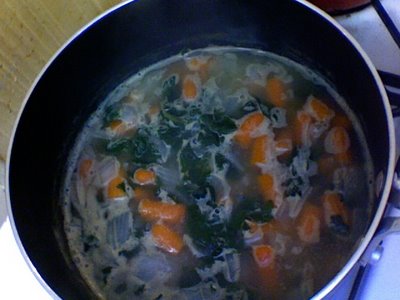 Taken with my computer, while holding my computer upside-down over the soup. Talented photographer, eh?
I hate cooking. I'm terrible at cooking. Which is the main reason I hate doing it. But the other day, someone told me about a carrot soup that they make that sounded delicious, so today I decided to try to make it.
While searching for a good recipe, I came across another recipe for cold blueberry and yogurt soup, to be used primarily as a dessert. So I decided to make them both.
The blueberry concoction has turned out nicely, I think; it's chilling at the moment. And the carrots, onions and spinach for the soup are simmering and getting mushy. About to be pulverized; I can't wait.
I also purchased a nice little piece of salmon to eat with the soup. And some Lone Star. And it's actually fun. I'm starting out simple, and hoping to gradually become more and more culinarily (is that a word?) skilled.
Here's a picture of my boiling soup (pre-mashing):
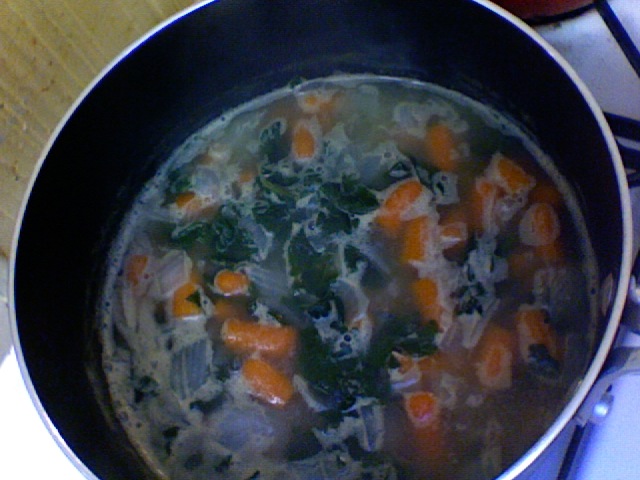 Taken with my computer, while holding my computer upside-down over the soup. Talented photographer, eh?
Subscribe to:
Posts (Atom)